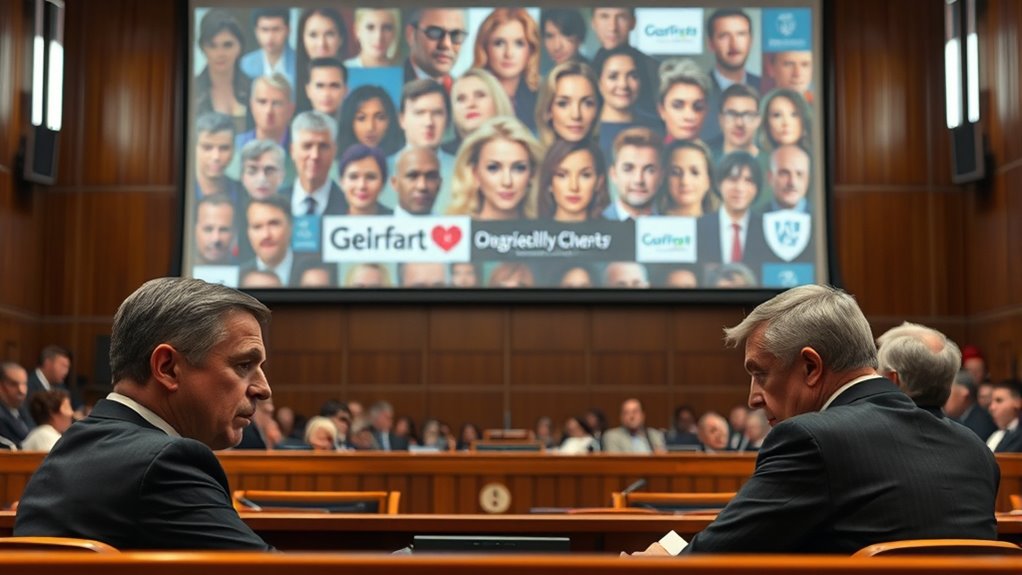

Steve Bannon’s “We Build the Wall” charity fraud case entangled celebrities and public figures because it involved high-profile personalities promoting a campaign that falsely claimed donations would go solely to border wall construction. As money was secretly diverted and disguised through third-party entities, it became hard to hold everyone accountable. The involvement of well-known figures added media scrutiny and complexity, highlighting the challenges of tracking political fundraising schemes. Continuing further reveals how transparency failures fueled this notorious case.
Key Takeaways
- Celebrities like Steve Bannon publicly promoted the campaign, making their involvement highly visible and scrutinized.
- Their association with the scheme increased media attention, complicating legal investigations and public perception.
- High-profile figures’ involvement blurred lines between political advocacy and potential financial misconduct.
- The entanglement heightened the case’s complexity, involving both legal charges and reputational risks for celebrities.
- Public and legal scrutiny of celebrity participation emphasized accountability and transparency in political fundraising efforts.

Recent charity fraud allegations have spotlighted how some campaigns exploit donor trust for personal gain. When you hear about the “We Build the Wall” campaign, it’s clear how even well-intentioned donors can be misled. The campaign promised that 100% of donations would go directly toward constructing the U.S.-Mexico border wall. But behind the scenes, the funds were secretly redirected to pay salaries, violating what donors believed their money would accomplish. Central to this deception was Brian Kolfage, the campaign’s president, who received upfront payments of $100,000 and about $20,000 each month. These payments were concealed from donors, with money laundering through third-party entities used to hide the true payees. The scheme was designed to give the false impression that the funds were solely for wall construction, but in reality, much of it lined the pockets of those involved. Financial records proved that Kolfage was secretly paid, including a $100,000 upfront and monthly payments of ~$20,000, which was concealed from donors. Legal authorities took notice, especially in New York, where high-profile political and financial crimes are often prosecuted. Steve Bannon, a former White House chief strategist, was indicted in September 2022 for his role in defrauding donors. He later pleaded guilty in February 2025 to scheming to defraud, avoiding jail time through a plea agreement that resulted in a three-year conditional discharge. The agreement also barred him from directing nonprofits or fundraising activities in New York during his probation. Additionally, Bannon was prohibited from using donor data linked to the scheme, aiming to prevent further misuse of funds. Despite the plea deal, the case revealed that around $15 million was raised through online efforts, with donors under the false belief that their contributions would fund private wall construction. The involvement of public figures added layers of complexity and scrutiny. Brian Kolfage, a former Air Force veteran, was a prominent face of the campaign, emphasizing that he would receive no compensation—an outright deception intended to garner support. Bannon’s participation drew widespread media attention, especially given his past role in the White House. The case was pursued rigorously by Manhattan District Attorney Alvin Bragg, who has a reputation for high-profile political prosecutions. The case not only highlighted the vulnerabilities in nonprofit oversight but also raised questions about the legality and ethics of politically charged fundraising. This scandal exposed how easily donor trust can be exploited when transparency is lacking, especially considering the lack of regulatory oversight that often accompanies such campaigns. It prompted calls for tighter regulations and oversight of online fundraising campaigns, especially those linked to political causes. Restrictions placed on Bannon reflect a broader effort to prevent similar schemes, but the case also serves as a warning to donors and regulators alike. It underscores the importance of scrutinizing how charities operate, ensuring that funds are used as promised and that accountability is maintained. Ultimately, this case reveals how complex and intertwined charity fraud can become when public figures, political agendas, and financial deception collide.
Top picks for "charity fraud allegation"
Open Amazon search results for this keyword.
As an affiliate, we earn on qualifying purchases.
Frequently Asked Questions
What Are the Legal Consequences for Those Involved?
You face serious legal consequences if involved in this case. Bannon pleaded guilty to fraud, received a conditional discharge, and is barred from certain nonprofit activities. Civil lawsuits from donors may seek restitution, and professional repercussions, like disbarment, are possible. The case also highlights potential political and legal ramifications, emphasizing that criminal and civil actions can profoundly impact your reputation, financial standing, and future legal opportunities.
How Did Celebrities Become Linked to the Case?
Did you know that celebrities helped raise millions for the ‘We Build the Wall’ campaign? You become linked to the case because many public figures promoted or co-founded the effort, giving it high-profile visibility. Their involvement attracted media attention and legitimized the campaign, which drew scrutiny when fraud allegations surfaced. As a result, their roles in fundraising and promotion made them tangentially connected to legal issues surrounding misused donor funds.
What Role Did Social Media Play in Public Perception?
Social media plays a pivotal role in shaping your perception of the case by spreading narratives quickly and widely. It amplifies both support and criticism, often blurring lines between personal opinions and official stances. You’re influenced by celebrity endorsements, political debates, and legal updates shared online. The platform’s immediacy and virality make it easy for you to form opinions before full facts emerge, deeply impacting public understanding and sentiment.
Are There Ongoing Investigations Into Other Charity Frauds?
Ongoing investigations into charity frauds are like a tangled web, revealing more victims as the search continues. You should know that authorities are probing various schemes, including cyberattacks, impersonation scams, and misappropriation of funds. With new legislation, larger charities face stricter scrutiny, and cyber threats grow more sophisticated. As a result, you must stay informed and vigilant, because the fight against charity fraud isn’t over yet and risks are evolving rapidly.
How Can Donors Protect Themselves From Similar Scams?
To safeguard yourself from scams, you should always research charities on trusted platforms like Charity Navigator and GuideStar. Use secure payment methods such as credit cards or PayPal, and avoid untraceable options like gift cards or cryptocurrencies. Verify the charity’s legitimacy by reviewing their financial disclosures, asking for updates, and checking their contact info. Stay cautious of urgent appeals and suspicious requests to ensure your donations are genuine and impactful.
Conclusion
You might be surprised to learn that over 70% of charitable fraud cases involve high-profile figures like Bannon, highlighting how celebrity influence can complicate accountability. As this case unfolds, it underscores the importance of transparency, especially when public trust is at stake. Stay vigilant and informed—because when celebrities get involved in charity, the line between genuine help and deception can quickly blur, impacting countless lives along the way.