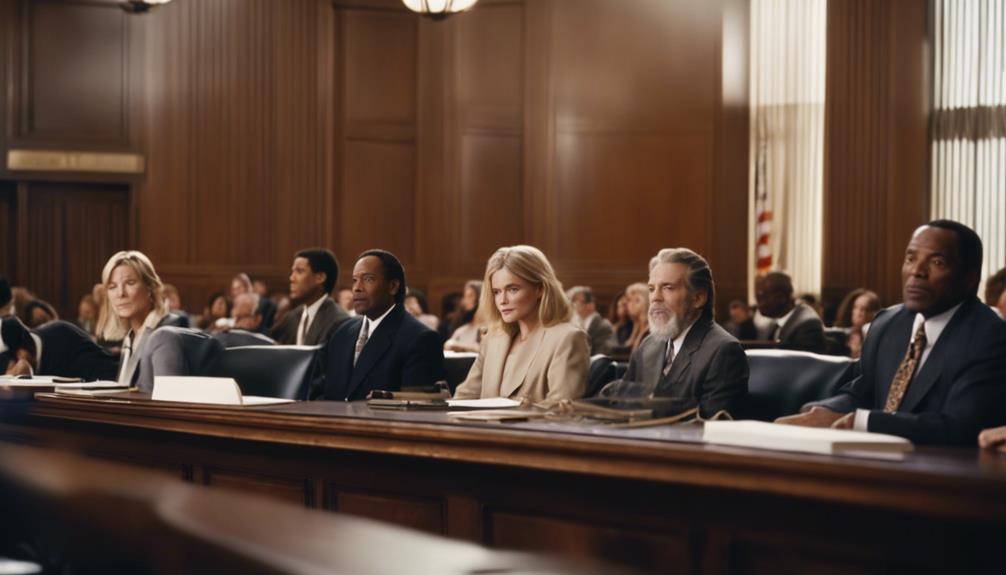


The Johnny Depp versus Amber Heard trial was a high-profile legal battle where Depp sued Heard for defamation after her 2018 op-ed described herself as a victim of domestic abuse. Heard countered with her own claim for $100 million. The court examined their abusive relationship, with both sides presenting detailed testimony and evidence. Depp was awarded damages, but the case highlighted how difficult it is to prove abuse and defamation. Keep exploring to understand what this landmark case reveals about justice and celebrity culture.
Key Takeaways
- Depp sued Heard for defamation over her 2018 op-ed claiming to be a domestic abuse survivor.
- The trial revealed detailed allegations of abuse from both sides, with eyewitness testimonies and expert analysis.
- The jury awarded Depp $10.35 million, finding Heard’s statements defamatory, though damages were limited by Virginia law.
- Heard was awarded $2 million after being found partially defamed by Depp’s statements.
- The case highlighted issues of domestic violence, free speech, and celebrity influence, making it a landmark legal and cultural event.

Johnny Depp vs. Amber Heard Trial
The Johnny Depp vs. Amber Heard case is one of the most talked-about legal battles in recent years. You might have heard about Depp suing Heard for defamation after her 2018 Washington Post op-ed, where she described herself as a “public figure representing domestic abuse.” Depp claimed her statement damaged his reputation and sought $50 million in damages. Heard responded with a countersuit, accusing Depp of defaming her and demanding $100 million. The trial started in April 2022 at the Fairfax County Circuit Courthouse in Virginia, lasting about six weeks, with the jury reaching a verdict on June 1. This case wasn’t just about legal claims; it became a global spectacle that spotlighted issues of domestic violence, free speech, and celebrity culture.
You should understand that Depp and Heard’s relationship began in 2012 after meeting on the set of the film *The Rum Diary*. They got engaged in 2014 and married in 2015. However, their marriage was tumultuous, with Heard filing for divorce in 2016 amid allegations of abuse. Their relationship was further complicated by legal issues like Heard’s 2015 charges related to illegally importing dogs into Australia. These events set the stage for the complex legal proceedings that followed. Their relationship’s tumultuous history significantly impacted the public perception and legal strategies employed during the case.
When the trial started, both Depp and Heard were present in court. Depp took the stand first, testifying for four days. He claimed Heard was the one who provoked abuse and that her op-ed caused him irreparable harm, making him lose career opportunities and respect. Heard, who testified from May 4 onward, painted a different picture. She described Depp as someone struggling with substance abuse and shared specific incidents, like a supposed “cavity search” during a vacation in 2013. The trial featured testimony from notable witnesses, including Kate Moss and Ellen Barkin, who added context and credibility to the claims. Additionally, the trial included expert testimony on domestic violence that shed light on the complexities of abuse allegations.
The jury ultimately found that Heard defamed Depp, awarding him $10.35 million in damages, although Virginia law limited punitive damages to $350,000, reducing the total. Depp won his main claim but also was found to have defamed Heard, awarding her $2 million in compensatory damages. Despite Depp’s victory, Heard announced plans to appeal, keeping the case’s aftermath in the spotlight. This trial highlighted the complexities of proving domestic abuse and defamation in civil courts, sparking debates about free speech, celebrity influence, and how society perceives allegations of abuse. It also demonstrated how high-profile legal battles can shape public understanding of sensitive issues, making it a landmark case in both legal and cultural history.

FUNBRO Pink Pocket Knife for Women – Slim EDC Knife with 7CR13Mov Steel Tanto Blade, Clip and Glass Breaker – Womens Knife for Self Defense – Cute Girl Survival Tool Pocket & Folding Knives
Tanto Blade: Featured great hardness and excellent corrosion resistance 7CR13Mov stainless steel sharp blade, this slim tanto knife…
As an affiliate, we earn on qualifying purchases.
As an affiliate, we earn on qualifying purchases.
Frequently Asked Questions
How Did the Trial Impact Each Celebrity’S Career?
You wonder how the trial affected their careers. For Johnny Depp, the verdict helped restore his image, with a favorable ruling and signs of a comeback despite media damage. Amber Heard, however, faces ongoing challenges; her reputation suffered, and her career prospects look bleak. Public opinion remains divided, making industry trust and future opportunities uncertain for both stars after the intense media scrutiny and legal battles.
Were There Any Key Witnesses That Changed the Trial’S Outcome?
So, you’re wondering if any witnesses pulled a surprise plot twist and changed the trial’s outcome? Well, Kate James’ testimony shed light on Amber’s behavior, but it didn’t flip the verdict. Experts like Shannon Curry and David Spiegel offered essential psychological insights that swayed perceptions. Their credibility and the contradictions among witnesses played a bigger role than a single witness. In the end, it was a mix of testimony and perception, not one star witness, that tipped the scales.
What Legal Standards Are Used in Defamation Cases Like This?
In defamation cases like this, you need to understand several legal standards. You must prove that a false statement was made as a fact, published to a third party, and caused harm to your reputation. If you’re a public figure, you also have to show “actual malice,” meaning the statement was made knowingly or recklessly. Truth is a complete defense, and the focus is on how third parties perceive the statement.
How Has Public Opinion Shifted Throughout the Trial?
You might think public opinion stayed fixed, but it actually shifted a lot during the trial. At first, support heavily favored Depp, fueled by celebrity status and sensational media. As new facts emerged, skepticism grew and people began questioning Heard’s credibility. Post-trial, awareness of manipulation tactics increased, leading some to reassess their views. Still, debates continue, and the case remains a symbol of societal struggles with victim credibility and media influence.
Will There Be Any Follow-Up Legal Actions After the Trial?
You might wonder if more legal actions will follow after the trial. Based on current information, no new lawsuits have been filed, and both parties seem to accept the damages awarded. The legal barriers, like statutes of limitations and high proof requirements, make additional claims unlikely. Since core issues have been addressed and no further disputes are publicly known, it’s safe to say the case is effectively settled.

ZHUKEYONG Legal Documents Kit, Durable Power of Attorney, Healthcare Directive and Last Will & Testament Forms, Self-Help Estate Planning Set
COMPREHENSIVE KIT: Complete legal document set including Living Will, Durable Power of Attorney, and Healthcare Directive forms for…
As an affiliate, we earn on qualifying purchases.
As an affiliate, we earn on qualifying purchases.
Conclusion
As you picture the courtroom, the tension hangs heavy in the air like a thick fog. The trial’s verdict illuminates the path forward, much like a lighthouse guiding ships through stormy seas. Whether you see justice served or questions remain, this case leaves a lasting imprint on your mind, reminding you how truth and perception can collide like crashing waves. In the end, it’s a story that lingers, etched into your memory like footprints in the sand.

Recover and Rebuild Domestic Violence Workbook: Moving On from Partner Abuse
As an affiliate, we earn on qualifying purchases.
As an affiliate, we earn on qualifying purchases.

NCE Practice Exam Kit, 750 Questions with Fully Explained Answers: National Counselor Certification Practice, Includes Flash Card Study System
As an affiliate, we earn on qualifying purchases.
As an affiliate, we earn on qualifying purchases.