
TL;DR

Get movie nights delivered free with Prime
- Fast, free delivery on millions of items
- Prime Video, Amazon Music and more included
- Member-only deals all year
A report by Vale.Rocks examines how DVD menus developed from a new feature into a memorable part of home video, with designs shaped by screen formats and the disc’s technical limits. The article is a retrospective, not a report of a newly announced product or event.
Vale.Rocks has published a retrospective on the design and technology of DVD menus, describing how interactive navigation became a selling point as the format spread and how its constraints shaped the experience. The account matters to home-video collectors and designers because it connects familiar menus, animations and hidden features to the standards and limited tools used to build them.
The report traces DVD menus from a format improvement over VHS and LaserDisc, which generally offered no comparable menu navigation, to more elaborate designs as DVD adoption grew. The format launched in late 1996, but Vale.Rocks says menus really came into their own in the 2000s, when players were widespread and publishers had learned how to use the format. Some early and lower-cost releases skipped menus and went directly to the content.
Menus ranged from a static background with a list of options to custom animation, audio, and content made specifically for the disc. Typical choices included playing the feature, selecting chapters or episodes, opening extras, and changing subtitles, language, audio or picture settings. The report also points to looping menu clips and abrupt audio endings as recurring traits that viewers remember.
The visual design had to account for different television shapes. DVD video commonly used 720 × 480 pixels in NTSC regions and 720 × 576 pixels in PAL regions, with metadata directing players how to display the image at the intended aspect ratio. During the shift from 4:3 televisions to widescreen, designers often kept key menu information inside a central 4:3 safe area, even when the surrounding image used a 16:9 frame.
The report shows that DVD menus were more than decorative screens: they were the viewer’s entry point to the feature, settings and bonus material. Their layouts had to work across televisions with different aspect ratios, which encouraged designers to preserve a central area for buttons and essential information while using the edges for atmosphere or decoration.
It also highlights the gap between what menus could look like and what the underlying technology could do. The format’s interaction system was limited, yet publishers produced menus with layered choices, motion and playful touches. That tension helps explain why menus became memorable to viewers and why their design remains of interest to people studying interface design and physical media.
As an affiliate, we earn on qualifying purchases.
DVD arrived in the late 1990s after VHS had become a familiar home-video format. Menu navigation and on-disc extras gave publishers new ways to organize content and promote additional material, but the first releases did not all use those features. The report describes the 2000s as the period when DVD menus became more developed, as the format matured and playback devices became common.
Vale.Rocks also explains the technical basis for the menus. DVD picture is carried as an MPEG-2 video stream; interactive highlights and subtitle graphics use subpictures, which support a limited palette. The DVD Virtual Machine has a small set of registers and a basic interaction system. Those constraints set boundaries for menu authors, even as they found ways to create custom and elaborate experiences.
One example of a publisher-wide approach is Disney FastPlay, which the report says debuted in 2004. It was designed to start a movie and selected bonus features automatically, reducing the need to operate a remote. In practice, the report says, FastPlay could begin with trailers, which led some viewers to bypass it for the main menu. Disney’s EasyFind menus also used recurring options and graphics to create a consistent interface across releases.
““Coming from VHS (or LaserDisc), which had no menus to speak of, this was a genuine improvement.””
— Vale.Rocks report
As an affiliate, we earn on qualifying purchases.
What the Retrospective Leaves Open
The supplied report does not identify a new product launch, policy change or other current event; it is a retrospective about DVD menu design. It also does not provide a survey, sales data or audience research quantifying how common particular menu styles were, or how many viewers used features such as FastPlay. Memories of looping clips and late-night playback are described as recollections, not measured findings.
The account gives general technical specifications and selected examples, but it does not catalogue individual releases or compare menus across publishers. The precise publication date is not included in the source material, and no future project or follow-up announcement is identified.
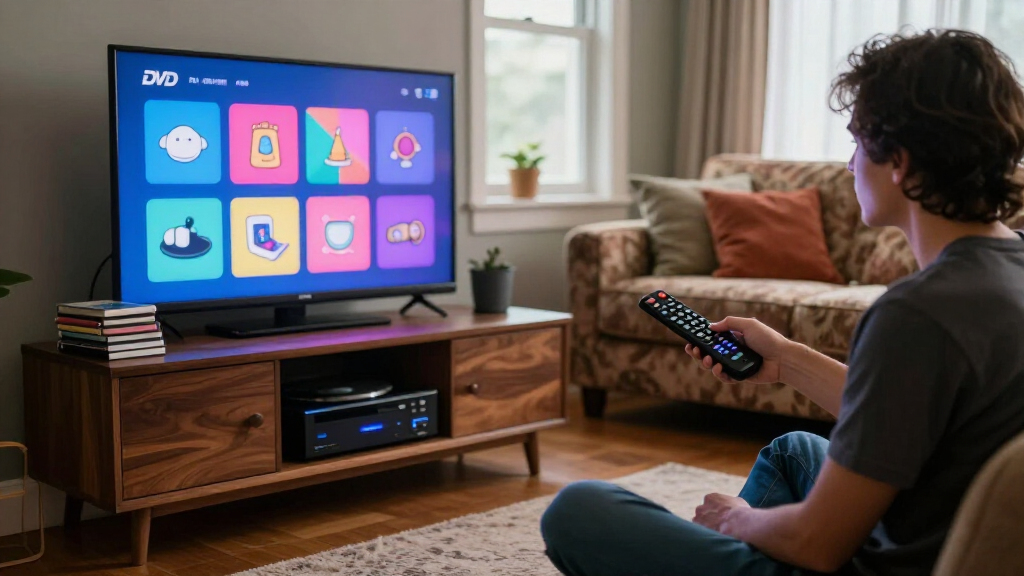
DVD player with customizable menus
As an affiliate, we earn on qualifying purchases.
As an affiliate, we earn on qualifying purchases.
No Follow-Up Announced
The source material describes no upcoming release, event or next reporting milestone. Readers interested in the subject can use the Vale.Rocks report as a starting point for exploring DVD menus and the technical standards behind them; the article cites Douglas Dixon’s DVD Authoring Terminology for additional technical detail. Any broader claims about the popularity or influence of specific menu designs would require further sourcing.
As an affiliate, we earn on qualifying purchases.
Key Questions
Is this report announcing a new DVD format or product?
No. It is a retrospective from Vale.Rocks about DVD menu design and the technology behind it, not an announcement of a new release.
When did DVD menus become more elaborate?
The report says DVD launched in late 1996, while menus became more developed in the 2000s as the format and playback technology matured.
Why did DVD menus keep important information near the center?
During the move from 4:3 televisions to widescreen, designers often kept key controls inside a 4:3 safe area so they remained visible across different display setups.
What was Disney FastPlay?
As described by Vale.Rocks, FastPlay was a feature introduced in 2004 that automatically started a movie and selected bonus features. Viewers could choose the main menu instead.
Source: hn
Halloween Picks
halloween
As an affiliate, we earn on qualifying purchases.