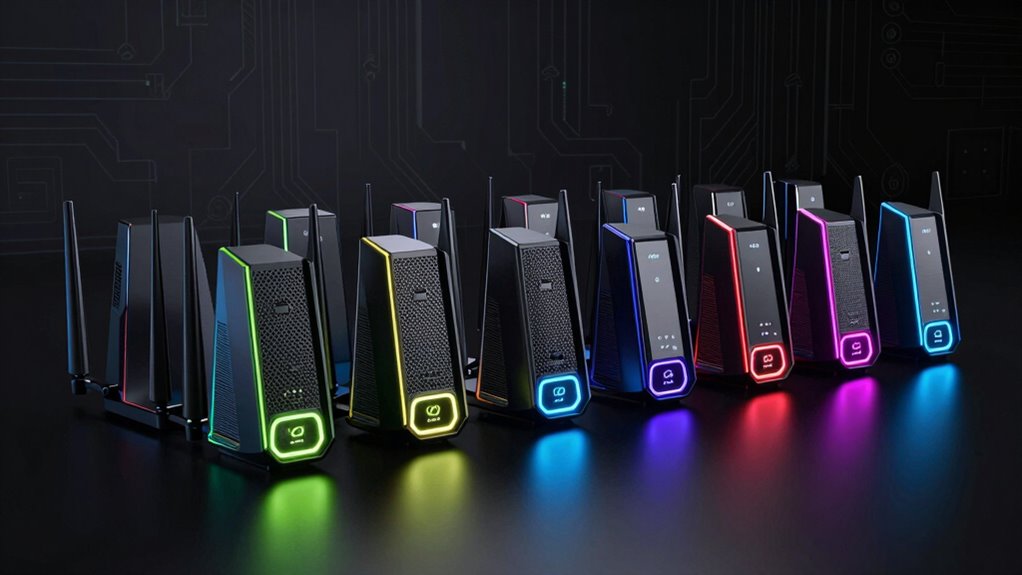

If you’re serious about gaming, a dedicated gaming router can significantly enhance your network performance. The best models offer low latency, fast speeds, and stable connections to keep you competitive. The main tradeoffs often involve balancing price, features, and ease of setup — high-end routers deliver top speed but come at a premium, while budget options might lack advanced features. Comparing these models reveals key differences in technology, user experience, and future-proofing. Continue reading to see a detailed breakdown of the 15 best gaming routers for 2026.

Get movie nights delivered free with Prime
- Fast, free delivery on millions of items
- Prime Video, Amazon Music and more included
- Member-only deals all year
Key Takeaways
- The highest-performing routers combine Wi-Fi 7 with multi-gig ports for the lowest latency and fastest speeds.
- Tri-band models generally outperform dual-band options in crowded network environments, especially for gaming.
- Premium routers often include advanced features like mesh compatibility, VPN support, and multiple Ethernet ports, but come with higher costs.
- Budget-friendly gaming routers can handle casual gaming well but may lack future-proof features like Wi-Fi 6E or Wi-Fi 7.
- Ease of setup and user interface quality vary widely; simpler models are better for beginners, while advanced setups suit tech-savvy users.
| TP-Link Tri-Band BE19000 Wi-Fi 7 Gaming Router (Archer GE800) |  | Best Overall for High-End Gaming and Whole-Home Coverage | Wi-Fi Speed: up to 19 Gbps | Bands: Tri-Band | Streams: 12 | VIEW ON AMAZON | See Our Full Breakdown |
| TP-Link Tri-Band AXE5400 Wi-Fi 6E Gaming Router Archer GXE75 |  | Best for Gamers Who Want Wi-Fi 6E and Dedicated Gaming Features | Wi-Fi Standard: Wi-Fi 6E | Tri-Band: Yes | Maximum Speed: 5.4 Gbps | VIEW ON AMAZON | See Our Full Breakdown |
| TP-Link AX1800 WiFi 6 Router (Archer AX21 V5) |  | Best for Budget-Conscious Users Needing Reliable Wi-Fi 6 | Wi-Fi Standard: Wi-Fi 6 (802.11ax) | Bands: Dual-band (2.4 GHz and 5 GHz) | Total Bandwidth: 1.8 Gbps | VIEW ON AMAZON | See Our Full Breakdown |
| NETGEAR Nighthawk Dual-Band WiFi 7 Router (RS90) |  | Best for Large Homes and Multi-Device Connectivity | Wireless Speed: up to 3.6 Gbps | Coverage: up to 2,000 sq. ft. | Device Capacity: 50 devices | VIEW ON AMAZON | See Our Full Breakdown |
| GL.iNet GL-MT6000 Flint 2 Wi-Fi 6 Gaming Router Dual 2.5G Ports |  | Best for Secure, High-Speed Gaming on a Budget | Wi-Fi Standard: Wi-Fi 6 | Max Speed: 6 Gbps | Ports: Dual 2.5G | VIEW ON AMAZON | See Our Full Breakdown |
| TP-Link Tri-Band WiFi 7 Router (Archer BE550) |  | Best Overall for Future-Proof Home Networks | WiFi Bands: Tri-Band | Maximum Speed: 5760 Mbps (6 GHz), 2880 Mbps (5 GHz), 574 Mbps (2.4 GHz) | Ports: 1 x 2.5G WAN, 4 x 2.5G LAN | VIEW ON AMAZON | See Our Full Breakdown |
| ASUS TUF Gaming BE6500 WiFi 7 Router – Dual-Band, Up to 6.5 Gbps Wireless, Game Accelerator, Multi-Link Operation, (x4) 2.5GbE Ports, Mesh + VPN Compatible, Subscription-Free Network Security |  | Best for Serious Gamers Needing Reliable, High-Speed Connections | WiFi Standard: WiFi 7 (802.11be) | Speed: Up to 6.5 Gbps | Bands: Dual-band | VIEW ON AMAZON | See Our Full Breakdown |
| TP-Link Dual-Band WiFi 7 Gaming Router Archer GE400 |  | Best for Budget-Conscious Gamers Seeking High-Speed WiFi | Maximum WiFi Speed: 5765 Mbps (5 GHz) and 688 Mbps (2.4 GHz) | Coverage Area: Up to 2,600 sq. ft. | Number of Devices Supported: Up to 90 devices | VIEW ON AMAZON | See Our Full Breakdown |
| ASUS ROG Rapture GT-BE98 Pro WiFi 7 Gaming Router – Quad-Band, 30Gbps, Mesh |  | Best for Ultra-High-Speed, Enterprise-Grade Gaming Networks | Frequency Band: Quad-Band | Max Data Transfer Rate: 30 Gbps | Number of Ports: 7 | VIEW ON AMAZON | See Our Full Breakdown |
| TP-Link AXE5400 Tri-Band WiFi 6E Router (Archer AXE75) |  | Best for Cutting-Edge WiFi 6E with Mesh and VPN Support | WiFi Speed: up to 5400 Mbps | Bands: Tri-Band (6 GHz, 5 GHz, 2.4 GHz) | Processor: 1.0 GHz dual-core CPU | VIEW ON AMAZON | See Our Full Breakdown |
| TP-Link BE6500 Dual-Band WiFi 7 Router (BE400) |  | Best Overall WiFi 7 Router for Versatile Home Use | Wi-Fi Technology: Wi-Fi 7 | Maximum Speed: 5764 Mbps (5GHz), 688 Mbps (2.4GHz) | Coverage: Up to 2,400 sq. ft. | VIEW ON AMAZON | See Our Full Breakdown |
| NETGEAR Nighthawk WiFi 7 Router (BE9300) |  | Best for Large Homes Needing Extensive Coverage and Device Support | Speed: 9.3 Gbps | Coverage: 2,500 sq. ft. | Device Capacity: 100 devices | VIEW ON AMAZON | See Our Full Breakdown |
| TP-Link Tri-Band BE11000 Wi-Fi 7 Gaming Router (Archer GE650) | | Best for Gamers Seeking High-Speed, Stylish Setup | Wi-Fi Bands: Tri-band (6 GHz, 5 GHz, 2.4 GHz) | Maximum Speed: 5764 Mbps (6 GHz), 4320 Mbps (5 GHz), 574 Mbps (2.4 GHz) | Ports: 1× 5 Gbps WAN, 1× 5 Gbps LAN, 3× 2.5 Gbps LAN | VIEW ON AMAZON | See Our Full Breakdown |
| MSI Radix AXE6600 WiFi 6E Tri-Band Gaming Router |  | Best for High-Speed WiFi 6E Gaming and AI Optimization | Tri-band: 2.4GHz + 5GHz + 6GHz | WiFi Standard: WiFi 6E | Streams: 8 streams | VIEW ON AMAZON | See Our Full Breakdown |
| ASUS ROG Strix GS-BE12000 WiFi 7 Gaming Router – Tri-Band, 12Gbps, Mesh |  | Best for High-End Gaming with Mesh Flexibility | WiFi Standard: WiFi 7 (802.11be) | Maximum Speed: 12 Gbps | Wired Capacity: 20G | VIEW ON AMAZON | See Our Full Breakdown |
| gaming router | Ports |
|---|---|
| TP-Link Tri-Band BE19000 Wi-Fi | 2x 10 Gbps, 4x 2.5 Gbps |
| TP-Link Tri-Band AXE5400 Wi-Fi | 1 x 2.5G WAN, 4 x 1G LAN |
| TP-Link AX1800 WiFi 6 Router | — |
| NETGEAR Nighthawk Dual-Band Wi | — |
| GL.iNet GL-MT6000 Flint 2 Wi-F | Dual 2.5G |
| TP-Link Tri-Band WiFi 7 Router | 1 x 2.5G WAN, 4 x 2.5G LAN |
| ASUS TUF Gaming BE6500 WiFi 7 | 4 x 2.5GbE (1 WAN, 3 LAN) |
| TP-Link Dual-Band WiFi 7 Gamin | 1x 2.5 Gbps WAN/LAN, 1x 2.5 Gbps LAN, 3x 1 Gbps LAN |
| ASUS ROG Rapture GT-BE98 Pro W | — |
| TP-Link AXE5400 Tri-Band WiFi | — |
| TP-Link BE6500 Dual-Band WiFi | 1x 2.5 Gbps WAN/LAN, 1x 2.5 Gbps LAN, 3x 1 Gbps LAN |
| NETGEAR Nighthawk WiFi 7 Route | — |
| TP-Link Tri-Band BE11000 Wi-Fi | 1× 5 Gbps WAN, 1× 5 Gbps LAN, 3× 2.5 Gbps LAN |
| MSI Radix AXE6600 WiFi 6E Tri- | — |
| ASUS ROG Strix GS-BE12000 WiFi | — |
More Details on Our Top Picks
TP-Link Tri-Band BE19000 Wi-Fi 7 Gaming Router (Archer GE800)
The TP-Link Archer GE800 stands out for its impressive Wi-Fi 7 speeds up to 19 Gbps across three bands, making it ideal for multi-device gaming setups and streaming. Its multi-link operation and 8 antennas ensure robust coverage and minimal latency, surpassing even the high-end ASUS TUF BE6500 in raw capacity. However, this router’s advanced features come with a high price tag and a complex setup process that might challenge less technical users. Its support for seamless mesh integration means it can extend coverage effortlessly, but only if you have compatible devices and a demanding network environment. Compared with the ASUS ROG Rapture GT-BE98 Pro, the GE800 offers faster speeds and more ports, but at the expense of simplicity and affordability. This pick makes the most sense for gamers and power users who prioritize top speeds and extensive coverage over ease of setup.
Pros:- Exceptional Wi-Fi 7 speed capacity up to 19 Gbps for gaming and streaming
- Multiple 10 Gbps high-speed ports for demanding setups
- Supports seamless mesh networking for large homes
- Customizable RGB lighting adds aesthetic appeal
Cons:- High cost may be prohibitive for many buyers
- Complex setup may overwhelm less technical users
- Requires Wi-Fi 7 compatible devices to reach full speed
Best for: Enthusiasts seeking maximum Wi-Fi 7 performance and whole-home coverage with customizable aesthetics
Not ideal for: Casual users or those on a budget who prefer straightforward installation and basic features
- Wi-Fi Speed:up to 19 Gbps
- Bands:Tri-Band
- Streams:12
- Antennas:8
- Ports:2x 10 Gbps, 4x 2.5 Gbps
- Processor:Quad-core with 2GB RAM
- Lighting:RGB customizable
- Mesh Compatibility:Yes
Our verdict“This router is best suited for tech-savvy gamers and homes needing maximum speed and coverage, despite its premium price and setup complexity.”
TP-Link Tri-Band AXE5400 Wi-Fi 6E Gaming Router Archer GXE75
The TP-Link Archer GXE75 offers tri-band Wi-Fi 6E speeds up to 5.4 Gbps, making it a strong choice for gamers who want the latest wireless standard without the huge price tag of Wi-Fi 7. Its dedicated gaming acceleration and real-time network insights provide a noticeable advantage over older Wi-Fi 6 routers like the AX1800 AX21, especially for latency-sensitive activities. The inclusion of a 2.5 Gbps WAN port simplifies high-speed internet connections, but its premium price and complex feature set may be overkill for casual users. While it supports whole-home coverage with EasyMesh, its advanced options might require some technical familiarity. Compared to the NETGEAR RS90, the GXE75 excels in gaming-specific features but doesn’t match the RS90’s broader device capacity or coverage area. This router suits serious gamers who want the latest Wi-Fi technology and dedicated features without stepping into Wi-Fi 7 territory.
Pros:- High-speed tri-band Wi-Fi 6E with up to 5.4 Gbps
- Dedicated gaming acceleration and real-time insights
- Easy setup via Tether app
- Supports whole-home coverage with EasyMesh
Cons:- Premium pricing limits accessibility
- Complex configuration for users unfamiliar with advanced networking
- Limited to Wi-Fi 6E, missing Wi-Fi 7 advantages
Best for: Dedicated gamers and tech enthusiasts who desire Wi-Fi 6E with advanced gaming optimization
Not ideal for: Average households with basic internet needs or those seeking simple setup without advanced features
- Wi-Fi Standard:Wi-Fi 6E
- Tri-Band:Yes
- Maximum Speed:5.4 Gbps
- Ports:1 x 2.5G WAN, 4 x 1G LAN
- Security:TP-Link HomeShield
Our verdict“Best suited for serious gamers wanting Wi-Fi 6E with dedicated game optimization, despite higher cost and complexity.”
TP-Link AX1800 WiFi 6 Router (Archer AX21 V5)
The TP-Link Archer AX21 V5 delivers dual-band Wi-Fi 6 speeds up to 1.8 Gbps, making it an appealing choice for users who want solid performance without breaking the bank. Its dual-band setup covers typical home environments well, supporting multiple devices with OFDMA technology for efficiency. While it doesn’t support the 6 GHz band, it outperforms older Wi-Fi standards and offers reliable security features, making it suitable for streaming, gaming, and everyday use. Compared with higher-end Wi-Fi 6E routers like the GXE75, the AX21 is more affordable but lacks the spectrum and future-proofing of Wi-Fi 6E. Its performance can vary depending on device placement and environment, but it remains a dependable middle-ground option for typical households that prioritize value over cutting-edge features.
Pros:- Affordable Wi-Fi 6 speeds up to 1.8 Gbps
- Supports multiple devices with OFDMA technology
- Good coverage with high-gain antennas
- Enhanced security features including VPN support
Cons:- Lacks support for the 6 GHz band of Wi-Fi 6E
- Performance may fluctuate based on environment
- No advanced gaming or mesh features
Best for: Budget-conscious families or individuals seeking reliable Wi-Fi 6 without extra frills
Not ideal for: Power users or gamers requiring ultra-fast speeds or Wi-Fi 6E features
- Wi-Fi Standard:Wi-Fi 6 (802.11ax)
- Bands:Dual-band (2.4 GHz and 5 GHz)
- Total Bandwidth:1.8 Gbps
- Maximum Speed:1200 Mbps on 5 GHz, 574 Mbps on 2.4 GHz
- Antennas:4 high-gain
- Security:Advanced security with VPN
Our verdict“A solid, budget-friendly Wi-Fi 6 router suitable for typical home use but not for power users or dedicated gamers.”
NETGEAR Nighthawk Dual-Band WiFi 7 Router (RS90)
The NETGEAR Nighthawk RS90 provides dual-band WiFi 7 speeds up to 3.6 Gbps, making it a practical choice for large homes or households with many devices. Its coverage up to 2,000 sq. ft. and capacity for 50 devices ensure stable connections across multiple users, outperforming older Wi-Fi 6 models like the AX1800 in speed and capacity. The inclusion of a 2.5 Gig WAN port enhances internet performance, but the actual speeds depend heavily on your plan and connected devices. Management via the Nighthawk app simplifies setup, but the subscription-based Armor security can be a downside for budget-conscious users. Compared with the AX1800, the RS90 offers better speed, coverage, and device handling, yet it may still fall short in environments requiring mesh solutions or full Wi-Fi 7 features.
Pros:- Fast Wi-Fi 7 speeds up to 3.6 Gbps
- Large coverage area of up to 2,000 sq. ft.
- Supports up to 50 devices simultaneously
- Multi-gig WAN port for high-speed internet
Cons:- Real-world speeds depend on connected devices and plans
- Mesh expansion requires additional hardware
- Armor security needs a subscription after trial
Best for: Large households needing reliable Wi-Fi 7 with high device capacity and broad coverage
Not ideal for: Small apartments or users seeking simple, budget-friendly Wi-Fi 6 solutions
- Wireless Speed:up to 3.6 Gbps
- Coverage:up to 2,000 sq. ft.
- Device Capacity:50 devices
- WAN Port:2.5 Gig
- Ethernet Ports:4 x 1G
- Compatibility:Most cable, fiber, DSL, satellite providers
Our verdict“Ideal for large homes with many devices, offering reliable Wi-Fi 7 performance despite some subscription costs.”
GL.iNet GL-MT6000 Flint 2 Wi-Fi 6 Gaming Router Dual 2.5G Ports
The GL.iNet GL-MT6000 Flint 2 offers an attractive combination of Wi-Fi 6 speeds up to 6 Gbps and dual 2.5 Gbps ports, making it a versatile choice for gamers who need both speed and security. Its capacity to support over 100 devices is impressive for its compact size, and built-in VPN support enhances privacy for gaming and streaming. Compared to the AX1800 AX21, the Flint 2 provides significantly higher throughput, but VPN speeds can vary depending on network conditions, and firmware updates are needed for optimal performance. Its price point makes it appealing for those who want high performance without premium costs, but it may lack some of the extensive features of pricier routers like the GXE75 or RS90. This router is ideal for users prioritizing speed, security, and device density on a budget.
Pros:- High-speed Wi-Fi 6 with up to 6 Gbps throughput
- Dual 2.5G ports for fast wired connections
- Supports over 100 devices simultaneously
- Built-in VPN options for secure gaming and browsing
Cons:- VPN speeds depend on network conditions
- Requires firmware updates for best performance
- Limited support for future Wi-Fi standards
Best for: Gamers and streamers seeking high-speed Wi-Fi 6 with strong security features at an affordable price
Not ideal for: Users needing Wi-Fi 7 or extensive mesh capabilities for very large homes
- Wi-Fi Standard:Wi-Fi 6
- Max Speed:6 Gbps
- Ports:Dual 2.5G
- RAM:1GB DDR4
- Storage:8GB eMMC
- VPN Speed:up to 900Mbps
Our verdict“A compelling choice for gamers wanting fast, secure Wi-Fi 6 on a budget with high device capacity.”
TP-Link Tri-Band WiFi 7 Router (Archer BE550)
The TP-Link Archer BE550 stands out for its tri-band WiFi 7 capability, delivering multi-gigabit speeds up to 5760 Mbps on the 6 GHz band. Compared with the ASUS TUF BE6500, it offers higher maximum speeds and seamless mesh support, making it ideal for households with heavy streaming and gaming needs. However, its setup can be complex for users unfamiliar with networking, and it requires a compatible modem for most ISPs. Its multiple 2.5G ports and advanced security features provide future-proofing, but non-technical users may find initial configuration daunting.
Pros:- High-speed tri-band WiFi 7 for seamless streaming and gaming
- EasyMesh support for whole-home coverage
- Multiple 2.5G ports for future-proof networking
- Enhanced security with TP-Link HomeShield
Cons:- Requires a modem for most ISPs
- Setup may be complex for non-technical users
Best for: Homeowners who want a high-speed, future-ready network with seamless coverage and security.
Not ideal for: Users seeking a simple, plug-and-play solution or those with limited technical knowledge.
- WiFi Bands:Tri-Band
- Maximum Speed:5760 Mbps (6 GHz), 2880 Mbps (5 GHz), 574 Mbps (2.4 GHz)
- Ports:1 x 2.5G WAN, 4 x 2.5G LAN
- Antennas:6 strategically positioned antennas
- Security:WPA3, HomeShield
- Compatibility:Alexa, Google Assistant, backward compatible with all WiFi generations
Our verdict“This router is perfect for tech-savvy households aiming for a robust, future-proof home WiFi system.”
ASUS TUF Gaming BE6500 WiFi 7 Router – Dual-Band, Up to 6.5 Gbps Wireless, Game Accelerator, Multi-Link Operation, (x4) 2.5GbE Ports, Mesh + VPN Compatible, Subscription-Free Network Security
The ASUS TUF Gaming BE6500 is designed specifically for gamers, with speeds up to 6.5 Gbps and features like multi-link operation to reduce latency. Compared to the TP-Link BE550, it emphasizes gaming stability with dedicated prioritization and multiple wired ports for low-latency connections. Its setup can be complex for users unfamiliar with advanced networking, and its premium price may deter casual users. While it offers built-in security and VPN support, detailed parental controls are less emphasized, making it more suited for dedicated gaming households rather than general users.
Pros:- High-speed WiFi 7 connectivity for gaming and streaming
- Multiple 2.5GbE ports for wired stability
- Game prioritization and multi-link operation improve latency
- Built-in security and VPN support for privacy
Cons:- Complex setup for non-technical users
- Premium price may be high for casual users
Best for: Hardcore gamers or streamers needing ultra-stable, low-latency internet with multiple wired connections.
Not ideal for: Casual users or families requiring simple, straightforward setup without gaming-specific features.
- WiFi Standard:WiFi 7 (802.11be)
- Speed:Up to 6.5 Gbps
- Bands:Dual-band
- Ports:4 x 2.5GbE (1 WAN, 3 LAN)
- Features:Game Accelerator, Multi-Link Operation, Mesh, VPN
- Security:Subscription-Free Security
Our verdict“This router is tailored for competitive gaming setups where stability and low latency are critical.”
TP-Link Dual-Band WiFi 7 Gaming Router Archer GE400
The TP-Link Archer GE400 offers solid dual-band WiFi 7 performance with speeds up to 5765 Mbps on 5 GHz, supporting up to 90 devices across a coverage area of 2,600 sq. ft. It’s a good choice for gamers who want high-speed internet with prioritized traffic without the complexity or cost of tri-band setups like the Archer BE550. Compared with the ASUS TUF BE6500, it lacks 6 GHz support and mesh compatibility, which limits future expansion. Its easy setup makes it appealing for casual gamers, but the absence of the 6 GHz band could be a downside as WiFi 7 adoption grows.
Pros:- High-speed dual-band WiFi with gaming optimization
- Supports up to 90 devices
- Easy setup via app or web interface
- Supports advanced security features
Cons:- Does not support 6 GHz WiFi band
- Not compatible with mesh WiFi systems like Deco
Best for: Budget-conscious gamers who want high-performance WiFi 7 without the extra complexity or price.
Not ideal for: Power users seeking tri-band coverage or those planning to expand with mesh systems.
- Maximum WiFi Speed:5765 Mbps (5 GHz) and 688 Mbps (2.4 GHz)
- Coverage Area:Up to 2,600 sq. ft.
- Number of Devices Supported:Up to 90 devices
- Ports:1x 2.5 Gbps WAN/LAN, 1x 2.5 Gbps LAN, 3x 1 Gbps LAN
- Antennas:6 external with Beamforming
- Security:TP-Link security services, Secure-by-Design
Our verdict“This router is a strong choice for gamers who prioritize speed and ease of use at a lower cost, but it lacks some future-proof features.”
ASUS ROG Rapture GT-BE98 Pro WiFi 7 Gaming Router – Quad-Band, 30Gbps, Mesh
The ASUS ROG Rapture GT-BE98 Pro is a powerhouse, with quad-band WiFi 7 delivering speeds up to 30Gbps and dual 10G ports for ultra-fast wired connections. Its external antennas and multi-band design provide extensive coverage, making it suitable for large homes or gaming setups demanding maximum throughput. Unlike the less advanced dual-band options like the GE400, it offers a more robust, enterprise-grade solution with app and touch controls, advanced security, and support for multiple devices simultaneously. However, the setup process can be complex, and its premium price might be prohibitive for casual users. Speed and coverage come with increased complexity and cost.
Pros:- Supports WiFi 7 speeds up to 30Gbps
- Quad-band design with extensive coverage
- Dual 10G ports for high-speed wired connections
- Advanced security and management features
Cons:- Complex setup for non-technical users
- High price point
Best for: Large households or esports enthusiasts needing maximum speed, coverage, and wired options.
Not ideal for: Casual users or those seeking an easy, affordable router with basic features.
- Frequency Band:Quad-Band
- Max Data Transfer Rate:30 Gbps
- Number of Ports:7
- LAN Port Bandwidth:10 Gigabit
- Control Method:App, Touch
- Security Protocols:WPA2-Enterprise, WPA3-Personal, WPS
Our verdict“This router is designed for high-demand environments where ultra-fast speeds and extensive coverage are non-negotiable.”
TP-Link AXE5400 Tri-Band WiFi 6E Router (Archer AXE75)
The TP-Link AXE5400 Archer AXE75 leverages WiFi 6E to deliver speeds up to 5400 Mbps across three bands, including the new 6 GHz spectrum for low latency and increased capacity. Compared with WiFi 7 options like the BE550 or ASUS TUF BE6500, it offers a more recent standard with wider device support and enhanced mesh capabilities. Its dual-core CPU and high-speed memory support reliable performance for demanding households, but it requires a modem for most ISPs and might be complex for users unfamiliar with advanced networking. While it offers excellent security and mesh options, it might not keep pace with WiFi 7’s future speeds.”
Pros:- Supports latest WiFi 6E standard with high speeds
- Tri-band design with OFDMA technology
- Supports mesh networking and VPN
- Enhanced heat dissipation for reliable performance
Cons:- Requires a modem for most ISPs
- Advanced features may be complex for casual users
Best for: Tech enthusiasts wanting the latest WiFi 6E features with mesh flexibility and VPN options.
Not ideal for: Casual users or households seeking WiFi 7 compatibility or simple setup.
- WiFi Speed:up to 5400 Mbps
- Bands:Tri-Band (6 GHz, 5 GHz, 2.4 GHz)
- Processor:1.0 GHz dual-core CPU
- Memory:512 MB High-Speed Memory
- Compatibility:Works with all major ISPs
- VPN Support:Yes
Our verdict“This router suits users eager to adopt WiFi 6E with mesh and security features, though it falls behind WiFi 7 in raw speed potential.”
TP-Link BE6500 Dual-Band WiFi 7 Router (BE400)
The TP-Link BE6500 stands out for delivering the latest Wi-Fi 7 technology with impressive speeds up to 5764 Mbps on the 5GHz band, making it ideal for high-bandwidth activities like streaming and gaming. Compared with the NETGEAR Nighthawk BE9300, it offers a more straightforward setup via mobile app and a slightly more compact design, but it lacks the tri-band flexibility and extensive device capacity of the BE9300. Its coverage up to 2,400 sq. ft. suits medium-sized homes, and its multi-gig ports support fast wired connections.
Tradeoffs include limited mesh compatibility—it’s not compatible with Deco systems—and the need for a separate modem. While security features like HomeShield are robust, firmware management details are less transparent. Overall, this makes sense for users prioritizing easy setup, security, and solid performance without requiring complex mesh configurations.
Pros:- Supports the latest Wi-Fi 7 technology for fast, reliable connections
- High bandwidth with multi-gig ports and extensive coverage
- Easy setup with mobile app and robust security features
Cons:- Not compatible with some mesh WiFi systems like Deco
- Requires a separate modem for internet connection
Best for: Home users who want a reliable, high-speed WiFi 7 connection with simple setup and good security features
Not ideal for: Large households needing extensive mesh coverage or advanced device management; users with existing mesh systems like Deco may find compatibility limited
- Wi-Fi Technology:Wi-Fi 7
- Maximum Speed:5764 Mbps (5GHz), 688 Mbps (2.4GHz)
- Coverage:Up to 2,400 sq. ft.
- Number of Devices Supported:Up to 90
- Ports:1x 2.5 Gbps WAN/LAN, 1x 2.5 Gbps LAN, 3x 1 Gbps LAN
- Security:Advanced cybersecurity features, VPN support
Our verdict“This router suits users seeking a straightforward, high-performance WiFi 7 option for average-sized homes.”
NETGEAR Nighthawk WiFi 7 Router (BE9300)
The NETGEAR Nighthawk BE9300 offers exceptional speeds up to 9.3 Gbps and broad coverage of 2,500 sq. ft., making it a top pick for large households with many smart devices. Its tri-band WiFi 7 setup surpasses the TP-Link BE6500 in device capacity and speed, but it’s bulkier and may be more complex to integrate with existing ISP gateways, sometimes requiring bridge mode. Its multiple wired ports allow for high-speed wired connections, ideal for gaming setups needing stable links.
Compared to the TP-Link BE6500, it provides greater device support and faster speeds, yet it may be overkill for smaller spaces or users with simpler needs. Its size and setup complexity could pose challenges for less tech-savvy users. Overall, this router is aimed at households demanding maximum coverage and device support without sacrificing speed.
Pros:- Fast WiFi 7 speeds up to 9.3 Gbps for demanding activities
- Wide coverage suitable for large homes
- Supports up to 100 devices simultaneously
- Multiple wired ports for high-speed connections
Cons:- Performance depends heavily on internet plan and device compatibility
- Larger size may be impractical for limited spaces
- Some ISP gateways may require bridge mode for optimal operation
Best for: Large households with extensive device counts and high internet demands, especially gamers and streamers needing reliable, fast connections
Not ideal for: Small apartments or users seeking a simple, budget-friendly router; those who prefer easy setup over maximum capacity
- Speed:9.3 Gbps
- Coverage:2,500 sq. ft.
- Device Capacity:100 devices
- WiFi Bands:Tri-band (2.4 GHz, 5 GHz, 6 GHz)
- LAN Ports:Two 2.5 Gigabit, two 1 Gigabit
- Compatibility:Works with existing modem or gateway
Our verdict“Ideal for large households that need high-speed, extensive coverage, and support for many devices without compromise.”
TP-Link Tri-Band BE11000 Wi-Fi 7 Gaming Router (Archer GE650)
The TP-Link Archer GE650 delivers tri-band Wi-Fi 7 with speeds up to 5764 Mbps on the 6 GHz band, tailored for gamers who need a lag-free experience. Its multiple gigabit ports, including 5 Gbps WAN and LAN, support ultra-fast wired connections, and its advanced Multi-Link Operation (MLO) technology optimizes network traffic for gaming. Compared to the MSI Radix AXE6600, it offers a more visually striking design with customizable RGB lighting, but setup can be more complex for those unfamiliar with advanced network configurations.
For gamers who prioritize aesthetics and high-speed gaming without extensive technical tinkering, this router hits the mark, but its premium price and large footprint could be drawbacks for casual users or those with limited space. The security features like HomeShield are comprehensive, but firmware updates might require more attention.
Pros:- High-speed tri-band Wi-Fi 7 with dedicated 6 GHz band
- Multiple gigabit ports support ultra-fast wired connections
- Advanced gaming optimization with WTFast and MLO technology
- Stylish design with customizable RGB lighting
Cons:- Complex setup may be daunting for non-technical users
- Premium price point might be prohibitive for some
- Large size may not fit in tight spaces
Best for: Dedicated gamers who want a high-performance, stylish router with advanced gaming features and customizable aesthetics
Not ideal for: Casual users or those with limited technical skills who prefer plug-and-play simplicity, or small spaces where size matters
- Wi-Fi Bands:Tri-band (6 GHz, 5 GHz, 2.4 GHz)
- Maximum Speed:5764 Mbps (6 GHz), 4320 Mbps (5 GHz), 574 Mbps (2.4 GHz)
- Ports:1× 5 Gbps WAN, 1× 5 Gbps LAN, 3× 2.5 Gbps LAN
- Technology:Multi-Link Operation (MLO), Wi-Fi 7, WTFast
- Design:Volcano-inspired with RGB lighting
Our verdict“Best suited for gamers who want maximum speed, stylish aesthetics, and advanced network management, willing to invest in a premium device.”
MSI Radix AXE6600 WiFi 6E Tri-Band Gaming Router
The MSI Radix AXE6600 supports WiFi 6E with 8 streams and speeds up to 6.6 Gbps, making it an excellent choice for gamers who require the latest Wi-Fi standard and multi-device support. Its AI QoS intelligently prioritizes gaming traffic, and the 1.8GHz quad-core processor ensures steady performance even during intensive gaming sessions. Compared with the TP-Link Archer GE650, it offers WiFi 6E compatibility, but at a slightly lower maximum speed and with a less customizable aesthetic—fewer RGB features.
This router fits well into gaming setups that value raw speed and smart data management, but its setup can be complicated for less experienced users, and the higher price might deter casual gamers. Its sleek design and gaming-focused features make it a compelling choice for dedicated gamers looking for future-proofing.
Pros:- Supports high-speed WiFi 6E with 8 streams and 6.6 Gbps max speed
- AI QoS for automatic traffic prioritization
- Powerful 1.8GHz quad-core processor ensures stability
- Customizable RGB lighting for aesthetic appeal
Cons:- Setup complexity may challenge beginners
- Higher price compared to WiFi 6 options
- Limited RGB customization compared to premium gaming routers
Best for: Hardcore gamers and tech enthusiasts who want WiFi 6E performance with AI-driven traffic management
Not ideal for: Casual users or those on a tight budget who do not need WiFi 6E or advanced features, or who prefer simpler setups
- Tri-band:2.4GHz + 5GHz + 6GHz
- WiFi Standard:WiFi 6E
- Streams:8 streams
- Speed:up to 6.6Gbps
- Processor:1.8 GHz quad-core
- Features:AI QoS, RGB Mystic Light
Our verdict“Ideal for gamers and tech-savvy users seeking future-proof WiFi 6E performance with smart traffic management.”
ASUS ROG Strix GS-BE12000 WiFi 7 Gaming Router – Tri-Band, 12Gbps, Mesh
The ASUS ROG Strix GS-BE12000 offers an eye-popping 12 Gbps maximum speed across tri-bands, making it a prime choice for ultra-demanding gaming and streaming setups. Its extensive wired capacity and eight internal antennas support a range of devices up to 3000 sq. ft., and its mesh compatibility allows seamless expansion—something the TP-Link BE6500 cannot match. However, the setup process is complex, and its size and price might be prohibitive for casual or space-constrained users.
Compared to the TP-Link BE11000, it offers a higher maximum speed and better mesh flexibility, but it’s more expensive and more complicated to configure. The advanced security and multiple SSIDs provide solid network protection, tailored for gamers who want ultimate control and low latency across multiple devices.
Pros:- Maximum speed up to 12 Gbps for demanding gaming and streaming
- Extensive wired capacity with 8 Gigabit ports
- Supports mesh networking for seamless coverage
- Advanced security with multiple SSIDs
Cons:- Complex setup may be overwhelming for novices
- High price point limits accessibility
- Large size may not fit in tight spaces
Best for: High-end gamers and streamers demanding maximum speed and extensive coverage with mesh capabilities and multiple security layers
Not ideal for: Entry-level users or small spaces where the size and complexity are unnecessary, or budget-conscious buyers
- WiFi Standard:WiFi 7 (802.11be)
- Maximum Speed:12 Gbps
- Wired Capacity:20G
- Mesh Support:Yes
- Number of Ports:7 x 2.5G
- Security:AiProtection Pro, Firewall
Our verdict“Best suited for gamers and streamers requiring top-tier speed, extensive coverage, and mesh flexibility at a premium cost.”

How We Picked
To evaluate these gaming routers, I focused on key performance factors that matter most for gaming, such as speed, latency, and stability under load. I also considered usability, including setup process and user interface, as well as build quality and future-proofing features like Wi-Fi 6E or Wi-Fi 7. Value was assessed by comparing feature sets relative to price, ensuring options cater to different budgets without sacrificing essential gaming performance. The ranking reflects a balance between performance, features, ease of use, and long-term viability, helping gamers choose the best fit for their specific needs.Factors to Consider When Choosing Gaming Routers
Selecting the right gaming router involves more than just looking at raw speed. Factors like network congestion, device compatibility, and future-proofing can dramatically influence your gaming experience. Understanding these aspects can help you avoid common pitfalls, such as overspending on unnecessary features or choosing a router that doesn’t support your setup. A well-chosen router ensures you get a stable, low-latency connection, whether you’re gaming alone or managing multiple devices. Keep in mind that the most expensive model isn’t always the best value for your specific setup, so consider your priorities carefully.Performance and Speed
For gaming, low latency and high sustained speeds are essential. Look for routers supporting Wi-Fi 6E or Wi-Fi 7 for the best future-proofing, as these standards offer less interference and higher throughput. Consider multi-gig Ethernet ports if you plan to connect gaming consoles or PCs directly for even lower latency. Keep in mind that raw speed isn’t everything; a router needs to handle multiple connected devices without slowdowns, especially in busy households.
Connectivity and Range
The size of your space and number of devices influence your choice. Tri-band routers can better manage congested networks, reducing lag during intense gaming sessions. Mesh compatibility might be worth considering if you have a large home or want seamless coverage. Remember that a router’s advertised range can be misleading; real-world performance depends on walls, interference, and device placement. Prioritize routers with multiple Ethernet ports if you want dedicated, wired connections for optimal stability.
Ease of Setup and Management
A user-friendly setup process saves time and frustration, especially for non-technical users. Look for routers with intuitive apps or web interfaces that allow quick configuration, firmware updates, and network management. Advanced options like QoS (Quality of Service) can prioritize gaming traffic but may be complex to optimize. A simpler interface can be more reliable over time and reduce the need for technical troubleshooting during critical gaming moments.
Future-Proofing and Additional Features
Investing in a router with Wi-Fi 6E or Wi-Fi 7 support can extend its relevance for years, especially as new devices adopt these standards. Additional features like VPN support, mesh compatibility, and multiple Ethernet ports offer flexibility but may increase cost. Be wary of overly feature-rich routers that might include unnecessary extras, pushing the price beyond your budget without clear benefit. Prioritize essential features that align with your gaming setup and online habits.
Price and Value
Higher prices typically correlate with better performance and future-proofing, but they aren’t always necessary for casual gamers. Budget models can still deliver satisfactory gaming experiences if they support Wi-Fi 6 or 5 GHz bands and have reliable throughput. Consider whether you need the latest standards or if a slightly older but proven model meets your needs. Always compare feature sets against cost to identify the best value, especially if you plan to upgrade components or devices soon.
Frequently Asked Questions
Do I need Wi-Fi 7 for gaming?
While Wi-Fi 7 is the latest standard and offers the lowest latency and highest speeds, it isn’t strictly necessary for gaming today. Wi-Fi 6E already provides significant improvements over previous standards, such as reduced interference and higher throughput. If you want to future-proof your setup and have compatible devices, investing in Wi-Fi 7 makes sense, but for most gamers, Wi-Fi 6E or even Wi-Fi 6 routers will suffice for now.
Is a tri-band router worth it for gaming?
Tri-band routers typically offer better performance in high-traffic environments by distributing devices across three separate bands, reducing congestion. This can lead to lower ping and more stable connections during intense gaming sessions, especially in households with multiple connected devices. However, they tend to be more expensive, so if your network isn’t heavily congested or you’re gaming alone, a dual-band router might be enough and save you money.
Should I prioritize Ethernet ports over Wi-Fi speed?
For gaming, wired connections via Ethernet usually provide the lowest latency and most stable experience. If you have the space and equipment to connect your gaming console or PC directly, prioritizing routers with multiple Ethernet ports or dedicated gaming ports can make a noticeable difference. Wi-Fi is convenient but can be affected by interference, walls, and congestion, so a combination of both wired and wireless options often yields the best results.
How important are mesh features for gaming routers?
Mesh capabilities are valuable if you have a large home or experience dead zones with your Wi-Fi coverage. For gaming, consistent coverage reduces lag caused by weak signals or dropped connections. However, mesh systems tend to be pricier and may introduce additional complexity. If your gaming setup is centralized in one area, a high-performance router without mesh might be sufficient, but for multi-room setups, mesh support can be a worthwhile investment.
Is it worth paying extra for gaming-specific features?
Gaming-specific features like QoS (Quality of Service), game acceleration, or gaming ports can enhance your experience by prioritizing gaming traffic. However, these features are often available on high-end routers that come at a premium. If your network is busy or you experience lag, these features can be beneficial. For casual gaming, a standard high-quality router with good throughput and stability may be enough without the added cost of gaming-specific optimizations.
Conclusion
For most gamers, the best overall choice is a high-performance Wi-Fi 7 router that balances speed, stability, and future compatibility. Budget-conscious players will find solid value in Wi-Fi 6 models with dual or tri-band setups. Premium gamers seeking the best experience should consider routers with mesh support, multiple Ethernet ports, and advanced features like VPNs. Beginners will benefit from user-friendly interfaces and straightforward setup, while those with large homes or multiple devices should prioritize mesh and coverage options. Tailoring your choice to your specific setup and priorities ensures a smoother gaming experience.
Halloween Picks
halloween
As an affiliate, we earn on qualifying purchases.