
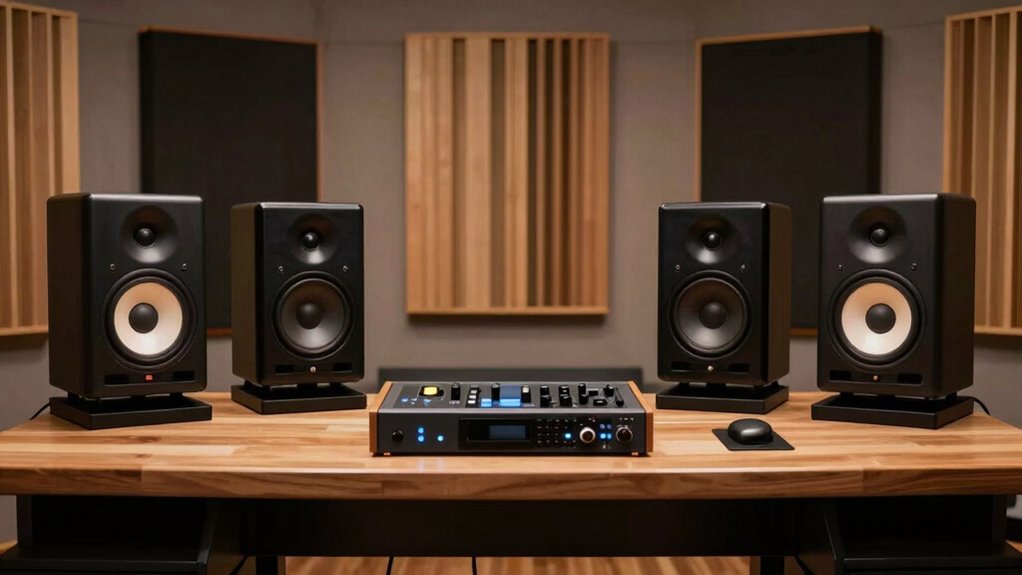

When selecting studio monitors, the goal is to find speakers that deliver accurate, flat sound for mixing and mastering. The Yamaha HS5 stands out as the overall best choice thanks to its precise sound and reliable build. For those on a budget, the PreSonus Eris E3.5 offers solid performance at a lower price, while the ADAM Audio D3V impresses with its detailed high-frequency response. These options reveal that tradeoffs often involve balancing sound fidelity, size, and affordability. Continue reading for a detailed breakdown of each monitor to find the best fit for your needs.

Get movie nights delivered free with Prime
- Fast, free delivery on millions of items
- Prime Video, Amazon Music and more included
- Member-only deals all year
Key Takeaways
- Accurate sound reproduction is the top priority across all top-rated monitors, with the Yamaha HS5 leading in clarity.
- Size matters: smaller monitors like the PreSonus Eris E3.5 are better for tight spaces, but larger speakers like the Yamaha HS4 offer fuller sound.
- Build quality and durability vary, with premium brands like ADAM Audio providing more robust construction for long-term use.
- Budget monitors can still deliver decent performance, but sacrificing some fidelity for affordability is common with entry-level options.
- Connectivity options differ, so consider your setup—some monitors include multiple inputs, which adds flexibility.
| ADAM Audio D3V Active Desktop Studio Monitor Speakers – Black |  | Best for Detailed Listening and Desktop Use | Woofer Size: 3.5 inches | Tweeter: 1.5-inch D-ART ribbon | Power: 80 W | VIEW ON AMAZON | See Our Full Breakdown |
| JBL 305P MkII 5-Inch 2-Way Active Studio Monitors (Pair) |  | Best for Versatile and Accurate Studio Monitoring | Size: 11.7 x 7.3 x 9.1 inches | Power: 2 x 41 Watts | Woofer Size: 5 inches | VIEW ON AMAZON | See Our Full Breakdown |
| PreSonus Eris E5 Pair 2-Way 5.25” Near Field Studio Monitors |  | Best for Accurate Mixing and Home Studios | Speaker Size: 5.25 inches | Power Output: 80 watts | Audio Output Mode: Stereo | VIEW ON AMAZON | See Our Full Breakdown |
| PreSonus Eris 3.5 Powered Desktop Studio Monitors, Pair – 50W, White |  | Best Compact Monitoring for Small Spaces | Power: 50W | Woofer Size: 3.5 inches | Tweeter Size: 1 inch | VIEW ON AMAZON | See Our Full Breakdown |
| Mackie CR3.5 Studio Monitors (Pair), 3.5-inch Woofers, Black |  | Best for Budget-Conscious Desk Setups | Number of Monitors: 2 | Woofer Size: 3.5 inches | Color: Black | VIEW ON AMAZON | See Our Full Breakdown |
| PreSonus Eris E4.5 2-Way 4.5-Inch Near Field Studio Monitor (Pair) |  | Best for Compact, Versatile Near-Field Monitoring | Size: 4.5 inches | Power: 50 Watts | Inputs: ¼-inch TRS, RCA, ⅛-inch TRS aux | VIEW ON AMAZON | See Our Full Breakdown |
| PreSonus Eris E7 XT 2-Way Active Studio Monitor |  | Best for Professional Mixing with Wide Imaging | Low-frequency driver: 6.55-inch woven composite | High-frequency driver: 1.25-inch silk-dome | Waveguide: EBM, 100°(H) x 60°(V) | VIEW ON AMAZON | See Our Full Breakdown |
| M-AUDIO BX3 3.5-Inch Wired Studio Monitors Pair |  | Best for Compact, All-in-One Desktop Monitoring | Driver Size: 3.5 inches | Power: 120W | Inputs: 1/4-inch, 1/8-inch, RCA | VIEW ON AMAZON | See Our Full Breakdown |
| Yamaha HS4 Powered Studio Monitor (Pair) |  | Best for Accurate, Balanced Sound in Small to Medium Studios | Woofer Size: 4.5 inches | Tweeter Size: 1 inch | Frequency Response: 60 Hz – 22 kHz | VIEW ON AMAZON | See Our Full Breakdown |
| PreSonus Eris 3.5 Powered Studio Monitors (Pair) |  | Best for Compact, Versatile Studio Sound in Small Spaces | Speaker Type: Active | Size: 3.5 inches | Power Output: 50 watts | VIEW ON AMAZON | See Our Full Breakdown |
| Yamaha HS5 Powered Studio Monitor, Pair |  | Best Overall for Accurate Studio Monitoring | Speaker Type: Woofer | Additional Features: Bi amplification | Power Output: 70 watts | VIEW ON AMAZON | See Our Full Breakdown |
| Yamaha HS5 W 5-Inch Powered Studio Monitor (White, 2-Pack) |  | Best for Versatile, Stereo Monitoring in Compact Spaces | Speaker Type: Monitor | Color: White | Speaker Size: 5 inches | VIEW ON AMAZON | See Our Full Breakdown |
| studio monitor | Inputs |
|---|---|
| ADAM Audio D3V Active Desktop | — |
| JBL 305P MkII 5-Inch 2-Way Act | XLR, TRS |
| PreSonus Eris E5 Pair 2-Way 5. | — |
| PreSonus Eris 3.5 Powered Desk | Balanced TRS, RCA, Aux |
| Mackie CR3.5 Studio Monitors | — |
| PreSonus Eris E4.5 2-Way 4.5-I | ¼-inch TRS, RCA, ⅛-inch TRS aux |
| PreSonus Eris E7 XT 2-Way Acti | — |
| M-AUDIO BX3 3.5-Inch Wired Stu | 1/4-inch, 1/8-inch, RCA |
| Yamaha HS4 Powered Studio Moni | XLR/TRS combo, RCA, Stereo Mini |
| PreSonus Eris 3.5 Powered Stud | TRS, RCA, Aux |
| Yamaha HS5 Powered Studio Moni | — |
| Yamaha HS5 W 5-Inch Powered St | — |
More Details on Our Top Picks
ADAM Audio D3V Active Desktop Studio Monitor Speakers – Black
The ADAM Audio D3V stands out for its precise high-frequency reproduction thanks to the D-ART ribbon tweeter, making it ideal for critical listening on a desktop. Compared with the JBL 305P MkII, it offers more refined highs but is less powerful and not suited for larger rooms. Its USB-C connectivity simplifies setup, which is a plus for digital workflows, though it’s primarily designed for desktop environments rather than expansive spaces. The inclusion of adjustable stands and a microphone mount adds versatility for content creators. However, its compact size limits bass extension, with extended lows down to only 45 Hz, and it can be costly for casual users. Best for music producers and songwriters needing accurate desktop monitoring who prioritize high-frequency detail over room-filling volume.
Pros:- Exceptional high-frequency accuracy with ribbon tweeter
- Easy connectivity via USB-C and balanced inputs
- Includes adjustable stands and microphone mount options
- Auto sleep mode conserves energy
Cons:- Limited bass response, may require subwoofer for full-range sound
- Designed primarily for desktop use, not for large rooms
Best for: Music producers and songwriters working on desktop setups who need precise high-end clarity
Not ideal for: Large studio environments or those needing powerful bass, as the monitor’s small size limits low-frequency output
- Woofer Size:3.5 inches
- Tweeter:1.5-inch D-ART ribbon
- Power:80 W
- Frequency Response:Down to 45 Hz
- Connectivity:USB-C, 1/4″ balanced inputs
- Additional Features:Headphone socket, volume knob, detachable stands, threaded microphone mount, auto sleep mode
Our verdict“This monitor makes the most sense for professionals requiring detailed desktop sound, accepting some bass limitations.”
JBL 305P MkII 5-Inch 2-Way Active Studio Monitors (Pair)
The JBL 305P MkII offers excellent clarity and imaging, making it a strong choice for mixing, podcasting, and sound design. Its dual 41-watt amplifiers and 5-inch woofer deliver a broad, dynamic sound, comparable to the PreSonus Eris E5 but with more straightforward controls. Its Boundary EQ and HF Trim allow users to tailor sound to room acoustics, which is a significant advantage over the Mackie CR3. However, JBL’s lack of detailed frequency response data can make it harder to gauge its full tonal capabilities, and it requires proper placement to sound its best. This monitor is better suited to dedicated studio spaces, as its size and power are designed for more serious work. Best for versatile, professional-grade monitoring in small to medium studios who want room customization.
Pros:- Accurate sound with precise imaging
- Customizable room controls via Boundary EQ and HF Trim
- Durable MDF enclosure with reliable power testing
- Versatile inputs suitable for professional setups
Cons:- Lack of detailed frequency response specs, making tonal evaluation harder
- Requires space and correct positioning for optimal sound
Best for: Producers and sound engineers seeking adaptable monitors with room tuning options
Not ideal for: Casual hobbyists or those with very limited space, due to the need for proper placement and setup
- Size:11.7 x 7.3 x 9.1 inches
- Power:2 x 41 Watts
- Woofer Size:5 inches
- Inputs:XLR, TRS
- Enclosure Material:MDF
- Peak SPL:108 dB
Our verdict“Ideal for small studios needing flexible, professional sound with room tuning capabilities.”
PreSonus Eris E5 Pair 2-Way 5.25” Near Field Studio Monitors
The PreSonus Eris E5 delivers reliable, flat response for professional mixing, with a 5.25-inch woven woofer and silk-dome tweeter. Its bi-amplification and acoustic tuning controls allow fine adjustments for a variety of room conditions, making it a versatile choice for serious home studios. Compared to the smaller Eris 3.5, the E5 provides deeper bass and more volume, suitable for larger rooms or more demanding projects. Nonetheless, it’s limited to nearfield use, which can be restrictive in bigger spaces, and it lacks wireless features for convenience. Its sturdy build and two-year warranty add peace of mind, but it requires careful placement for optimal sound. This monitor is best suited for those focused on precise sound for mixing at close range.
Pros:- Accurate, flat frequency response ideal for mixing
- Multiple input options for flexible connectivity
- Acoustic tuning controls for customized sound
- Solid build quality with warranty
Cons:- Limited to nearfield monitoring, not suitable for large rooms
- No wireless or Bluetooth features
Best for: Home studio owners and audio professionals seeking accurate nearfield monitoring
Not ideal for: Large spaces or casual listeners who want portable or wireless options
- Speaker Size:5.25 inches
- Power Output:80 watts
- Audio Output Mode:Stereo
- Mounting Type:Desktop
- Color:Black
- Warranty:2 Years
Our verdict“A dependable choice for professionals needing precise, nearfield sound reproduction.”
PreSonus Eris 3.5 Powered Desktop Studio Monitors, Pair – 50W, White
The PreSonus Eris 3.5 offers a compact yet capable solution for content creators, gamers, or media enthusiasts who need reliable sound in tight spaces. Its 3.5-inch woven-composite woofers and 1-inch silk-dome tweeters produce clear, balanced audio, comparable to larger monitors scaled down for desktop use. The adjustable high- and low-frequency controls help tailor sound to personal preferences and room acoustics, similar to the Eris E5 but in a smaller footprint. While its 50W power limits volume and bass extension compared to larger models, this monitor excels in delivering studio-quality sound in a minimal form factor. It’s not suitable for large rooms or loud environments, but it’s perfect for tight setups. Best for users needing discreet, accurate sound for casual production or media use.
Pros:- Compact and space-efficient design
- Delivers clear, balanced audio quality
- Multiple input options for versatility
- Built-in acoustic tuning controls
Cons:- Limited onboard power, not suitable for large rooms
- No included subwoofer for enhanced bass
Best for: Content creators, gamers, and small-space users needing reliable desktop monitoring
Not ideal for: Large studios or users requiring high volume and bass extension, due to its limited power
- Power:50W
- Woofer Size:3.5 inches
- Tweeter Size:1 inch
- Frequency Range:80 Hz–20 kHz
- Inputs:Balanced TRS, RCA, Aux
- Color:White
Our verdict“This monitor makes the most sense for those needing a small, accurate, and versatile desktop speaker set.”
Mackie CR3.5 Studio Monitors (Pair), 3.5-inch Woofers, Black
The Mackie CR3.5 delivers reliable sound for those working within tight budgets or small desks. Its 3.5-inch woofers produce a balanced tone suitable for casual mixing, streaming, or media playback. Compared to the PreSonus Eris 3.5, the Mackie offers similar size and sound but with more straightforward controls, which can be a plus for beginners. The inclusion of isolation pads helps improve sound clarity, although the basic controls may lack the nuance or flexibility sought by advanced users. Its compact form makes it ideal for small spaces, but it’s not designed for critical listening or large room setups. For budget-conscious users or those just starting out, it provides a decent entry point. Best for beginners or those with limited space and budget who want reliable sound without extra features.
Pros:- Compact and easy to place on small desks
- Reliable sound reproduction for casual use
- Includes isolation pads and cables
- Affordable price point
Cons:- Limited to small, casual setups
- Basic controls may not satisfy advanced users
Best for: Beginners or casual users needing affordable, compact monitors for desk use
Not ideal for: Professional studios or users seeking high accuracy, as controls are basic and sound quality is modest
- Number of Monitors:2
- Woofer Size:3.5 inches
- Color:Black
Our verdict“This monitor is ideal for entry-level users or tight spaces where budget is a priority but decent sound is still needed.”
PreSonus Eris E4.5 2-Way 4.5-Inch Near Field Studio Monitor (Pair)
The PreSonus Eris E4.5 stands out for delivering accurate, studio-quality sound in a compact form, making it ideal for small home studios or multimedia setups. Compared with the PreSonus Eris E7 XT, it offers a smaller footprint and easier placement, but sacrifices some low-end depth, requiring an external subwoofer for full-range response. Its multiple input options and room tuning controls provide flexibility for various workspace configurations. However, its 50W power may be insufficient for larger rooms or loud listening sessions, and it’s limited to near-field use, meaning it’s less suited for expansive studio setups. This pick makes the most sense for users prioritizing versatility and clarity over deep bass or high volume.
Pros:- Accurate, studio-quality sound for critical listening
- Multiple input options for versatile connectivity
- Room tuning controls for customized sound
Cons:- Requires external subwoofer for deep bass response
- Limited to near-field listening, not ideal for large spaces
Best for: Small home studio owners or multimedia creators needing accurate sound in limited space
Not ideal for: Musicians or producers needing full-range sound without external subwoofers or those working in large rooms
- Size:4.5 inches
- Power:50 Watts
- Inputs:¼-inch TRS, RCA, ⅛-inch TRS aux
- Woofer Material:Woven-composite
- Tweeter:Silk-dome
- Additional:Room tuning controls, headphone output
Our verdict“A strong choice for compact, detailed listening environments where space and versatility are priorities.”
PreSonus Eris E7 XT 2-Way Active Studio Monitor
The PreSonus Eris E7 XT offers a significant upgrade in size and sound clarity over the E4.5, featuring a 6.55-inch woven composite low-frequency driver and a 1.25-inch silk-dome high-frequency transducer. Its wide waveguide and included acoustic tuning controls enable precise placement and tailored sound, making it well-suited for detailed mixing and mastering. Unlike smaller monitors like the M-AUDIO BX3, which prioritize compactness, the E7 XT emphasizes accurate imaging and broader frequency response. Its higher price and larger size may be barriers for casual users or tight spaces, but it’s a better fit for serious producers needing clarity across the entire spectrum. It’s a step up in performance, but with added cost and space requirements.
Pros:- High-quality sound with broad, accurate imaging
- Includes acoustic tuning controls for customized response
- Comes with professional music production software
Cons:- Higher price point compared to smaller monitors
- Requires sufficient space for optimal placement
Best for: Professional or serious hobbyist producers seeking detailed, accurate sound and wide stereo imaging
Not ideal for: Casual listeners or producers working in small, cluttered spaces with limited budget
- Low-frequency driver:6.55-inch woven composite
- High-frequency driver:1.25-inch silk-dome
- Waveguide:EBM, 100°(H) x 60°(V)
- Included software:Studio One Prime and Studio Magic plug-in suite
- Features:Level, HPF, LF Trim, HF Trim, Acoustic Space controls
Our verdict“Ideal for dedicated producers who need precision and wide soundstage at a higher investment.”
M-AUDIO BX3 3.5-Inch Wired Studio Monitors Pair
The M-AUDIO BX3 pairs are a compact, wired solution that combines studio monitor quality with desktop convenience. Their 3.5-inch drivers deliver punchy bass and clear highs, making them suitable for multimedia, gaming, and light music production. Compared to larger monitors like the Yamaha HS4, these are significantly smaller, fitting easily on crowded desks, but they sacrifice some low-end depth and volume capacity. Their multiple inputs, including RCA and 1/8-inch, and included cables make immediate setup simple, but their size means they are less ideal for mixing in larger or acoustically challenging rooms. This model suits users who need reliable sound in tight spaces, though it’s overkill for casual listening or casual content creation.
Pros:- High-quality sound with clear highs and punchy bass
- Multiple input options for flexible connectivity
- Includes cables and software for quick setup
Cons:- Limited bass response due to small drivers
- Requires proper placement due to size for best sound
Best for: Desktop users needing professional-quality sound in limited space, such as streamers or home producers
Not ideal for: Professionals requiring high SPL for large rooms or bass-intensive music mixing
- Driver Size:3.5 inches
- Power:120W
- Inputs:1/4-inch, 1/8-inch, RCA
- Tweeter Type:Silk Dome
- Woofer Material:Kevlar
- Included Software:MPC Beats
Our verdict“A compact, easy-to-use option perfect for desktop setups where space is at a premium.”
Yamaha HS4 Powered Studio Monitor (Pair)
The Yamaha HS4 offers a classic, reliable performance with a 4.5-inch woofer and 1-inch dome tweeter, providing a balanced frequency response from 60 Hz to 22 kHz. Its room control and high trim response adjustments make it easy to tailor sound to various environments, similar to the PreSonus Eris E4.5, but with a slightly more refined high-frequency response. Its 26W power limits volume, making it suitable for small to medium rooms but less ideal for loud environments or large spaces. The included accessories, like the anti-slip pads, enhance stability and usability. It’s a dependable choice for those who want accurate sound reproduction without overcomplication, though its limited bass might require additional subs for full-range mixes.
Pros:- Accurate, balanced sound with clear high and mid frequencies
- Multiple input options for flexible connection
- Includes useful accessories like cables and anti-slip pads
Cons:- Limited bass response due to small woofer
- Power output may be insufficient for large or loud spaces
Best for: Small studio owners or content creators seeking balanced, transparent sound with straightforward controls
Not ideal for: Large studio setups or producers needing deep bass and high SPL levels
- Woofer Size:4.5 inches
- Tweeter Size:1 inch
- Frequency Response:60 Hz – 22 kHz
- Output Power:26 W
- Inputs:XLR/TRS combo, RCA, Stereo Mini
- Included Accessories:Cables, anti-slip pads
Our verdict“A dependable, balanced monitor suited for small studios and critical listening tasks.”
PreSonus Eris 3.5 Powered Studio Monitors (Pair)
The PreSonus Eris 3.5 monitors are ideal for tight spaces, delivering studio-quality sound with a 50W power output and adjustable high and low-frequency controls. Their compact size makes them perfect for desktop setups, gaming, or content creation. Compared with the larger Yamaha HS4, they offer similar sound clarity but in a smaller footprint, though their bass response is limited by the 3.5-inch drivers. The inclusion of multiple input options and a headphone jack enhances convenience, but they are less suitable for environments requiring high volume or deep bass. These monitors are best for users who want reliable, balanced sound without occupying much space, but they might fall short for more demanding mixing tasks.
Pros:- Compact size fits well on any desk
- Powerful 50W output with distortion-free sound
- Adjustable tone controls for personalized sound
Cons:- Limited bass due to small size
- No wireless connectivity, external power needed
Best for: Content creators, gamers, or small studio users needing compact, balanced monitors
Not ideal for: Producers needing deep bass or high SPL for large room mixing
- Speaker Type:Active
- Size:3.5 inches
- Power Output:50 watts
- Inputs:TRS, RCA, Aux
- Features:Built-in headphone jack, adjustable controls
- Mounting Type:Desktop, Bookshelf
Our verdict“A practical choice for small, versatile spaces where clear, balanced sound is required.”
Yamaha HS5 Powered Studio Monitor, Pair
The Yamaha HS5 stands out as the overall best choice for those seeking a neutral, precise sound for mixing. Its 5-inch woofer and 1-inch dome tweeter deliver a flat frequency response, making it ideal for critical listening—especially when compared to smaller monitors like the PreSonus Eris 3.5, which lack the low-end extension necessary for full-range accuracy. The bi-amplified design ensures clean, powerful output without distortion, but the monitor’s size demands a spacious setup and proper placement to avoid bass muddiness. While the build quality is robust, the size might be a challenge for compact studio environments. This monitor is best suited for professional producers and audio engineers who prioritize fidelity over portability or space-saving design.
Pros:- Highly accurate sound reproduction for critical mixing
- Bi-amplified system delivers clear, powerful audio
- Flat frequency response ensures true-to-source monitoring
- Durable MDF enclosure enhances longevity
Cons:- Large size requires significant space and proper placement
- No waterproofing, unsuitable for outdoor or humid environments
Best for: Professional music producers and mixing engineers needing precise, flat response audio in a dedicated studio space
Not ideal for: Home hobbyists with limited space or those needing portable monitors for on-the-go setups
- Speaker Type:Woofer
- Additional Features:Bi amplification
- Power Output:70 watts
- Frequency Response:54 Hz to 30 kHz
- Woofer Diameter:5 inches
- Input Types:XLR, TRS
Our verdict“This monitor is ideal for professionals who need precise, reliable sound in a spacious studio environment.”
Yamaha HS5 W 5-Inch Powered Studio Monitor (White, 2-Pack)
The Yamaha HS5 W bundle offers a practical solution for those who want a stereo pair of monitors with versatile connectivity, especially suitable for desktop or smaller studio setups. Its 5-inch driver and bi-amplified design echo the precision of the standard HS5 but with additional features like a USB port and high-resolution audio support, making it more adaptable for multimedia work. Compared to the single HS5, this bundle provides immediate stereo imaging, but the size and weight mean it’s less suitable for portable or space-constrained environments. The white finish adds a sleek, modern look that integrates well into home or project studios. This pick makes the most sense for musicians and content creators who need accurate sound but have limited space, and value a complete stereo setup.
Pros:- Accurate sound reproduction suitable for mixing and editing
- Includes a stereo pair for balanced monitoring
- Bi-amplified design enhances clarity and response
- Versatile connectivity options, including USB and high-res audio
Cons:- Expensive compared to single monitors, may be a hurdle for casual users
- Requires adequate space for proper placement due to size
Best for: Home studio owners, content creators, and musicians seeking a reliable stereo setup with flexible connectivity
Not ideal for: Professionals requiring the highest precision in large-scale or acoustically treated studios
- Speaker Type:Monitor
- Color:White
- Speaker Size:5 inches
- Additional Features:Bass Boost, Hi Res Audio, USB Port
- Power Source:Corded Electric
- Dimensions:18″D x 23.7″W x 18.3″H
Our verdict“This bundle is well-suited for creators who need a compact, versatile, and accurate stereo monitoring solution.”
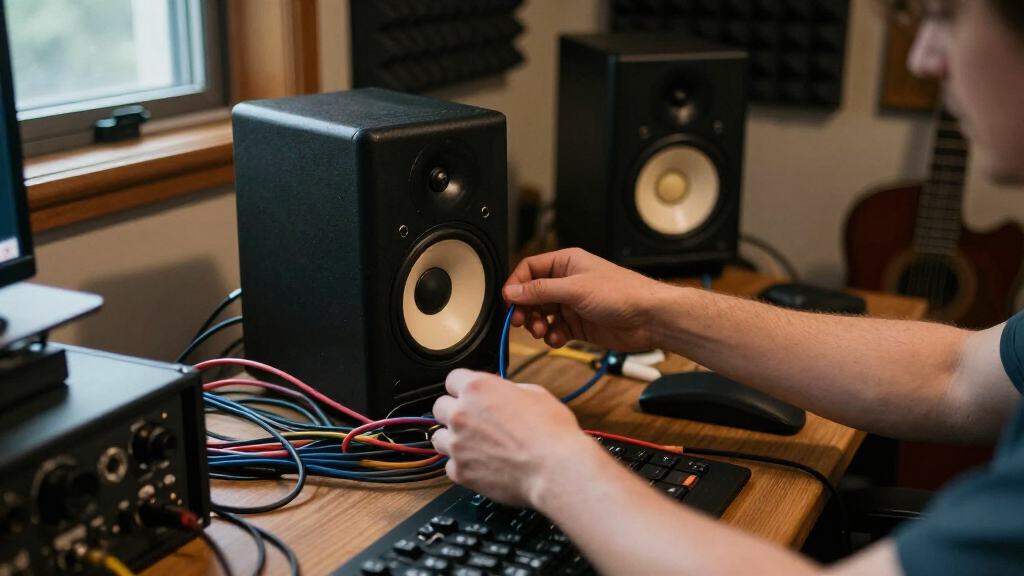
How We Picked
Our evaluation focused on core performance factors such as sound accuracy, frequency response, and clarity, which are essential for mixing and mastering. We also considered build quality, user interface, and ease of use for both beginners and professionals. Price-to-performance ratios helped us distinguish whether a monitor offers good value at its price point. Lastly, we looked at size and connectivity options to ensure the selections cater to different studio setups, with an emphasis on models that deliver consistent results across various environments.
Factors to Consider When Choosing Studio Monitors
Choosing the right studio monitor involves balancing several factors beyond just sound quality. Understanding your space, budget, and intended use helps narrow down your options. The following considerations can help you avoid common pitfalls and select a monitor that truly meets your needs.Size and Space Compatibility
Monitor size influences both sound and fit within your workspace. Larger speakers like the Yamaha HS8 provide more bass and volume but require more room, making them unsuitable for small studios. Smaller monitors, such as the PreSonus Eris E3.5, fit compact spaces better but may lack the low-end depth needed for certain genres. Assess your room dimensions and placement flexibility before choosing a size, as improper fit can lead to inaccurate sound perception.
Frequency Response and Accuracy
For professional mixing, a flat frequency response that reveals all aspects of your audio is vital. Cheaper monitors often color the sound, potentially misleading your mixing decisions. Premium models tend to have more neutral response curves, which is critical for precise editing. Remember, a monitor that emphasizes bass or treble might sound appealing initially but can distort your mix’s true balance.
Connectivity and Compatibility
Check what inputs your studio setup requires—XLR, TRS, RCA? Some monitors offer multiple connection options, providing greater flexibility for different interfaces and audio sources. Fewer inputs might limit future expansion or multi-device use. Also, consider whether the monitor has volume controls and other features like room calibration, which can enhance your workflow.
Build Quality and Durability
Studio monitors are an investment, so durability matters. Higher-end models often feature more robust cabinets and components that sustain consistent performance over time. Cheaper units sometimes suffer from vibration issues or component wear, which can compromise sound quality. Picking a well-constructed monitor ensures longevity and reliable performance, especially in demanding studio environments.
Price and Value
While it’s tempting to go for the most affordable option, investing slightly more can significantly improve your experience and results. Entry-level monitors might lack clarity or bass response, leading to longer mixing sessions or less confident decisions. Conversely, high-end models deliver superior accuracy but may exceed budget constraints. Aim for a model that offers the best balance of features, performance, and price for your specific needs.
Frequently Asked Questions
Do I need powered or passive studio monitors?
Most modern studio monitors are powered, meaning they have built-in amplifiers, which simplifies setup and reduces clutter. Powered monitors are generally more convenient for beginners and small studios, offering plug-and-play simplicity. Passive monitors require an external amplifier, which adds complexity and cost but can be advantageous in larger or more customized setups. Consider your space and technical comfort level when choosing between powered and passive options.
How important is room size when choosing studio monitors?
Room size significantly influences monitor selection because smaller spaces can exaggerate bass and reflections, affecting sound accuracy. In tight quarters, smaller monitors like the PreSonus Eris E3.5 or Yamaha HS5 are better suited, as they won’t overwhelm the space. Larger rooms can accommodate bigger speakers with deeper low-end response, like the Yamaha HS8. Proper room treatment combined with appropriate monitor size is essential for achieving accurate sound.
Should I prioritize sound quality over connectivity options?
While sound quality is paramount, connectivity options are also important, especially if you plan to expand or diversify your setup. If your interface only has XLR outputs, ensure your monitors support XLR inputs—this minimizes noise and maximizes clarity. However, sacrificing a bit of fidelity for better connectivity can be justified if it simplifies your workflow or future-proofs your studio. Strive for a balance that matches your current and future needs.
Are higher-priced monitors worth the investment?
Higher-priced monitors typically offer flatter frequency responses, better build quality, and more precise sound, which can significantly improve your mixing accuracy. If you’re a professional or serious hobbyist, investing in premium monitors like the Adam Audio D3V or Yamaha HS8 can pay off in the long run. For casual or beginner use, mid-range models may suffice, but be aware that lower-cost options might require compromises in clarity and detail.
How do I know if a monitor is suitable for my genre of music?
Different genres benefit from different sound profiles. For example, electronic and bass-heavy music require monitors with strong, accurate low-end reproduction, while acoustic or classical music may prioritize midrange and high-frequency clarity. Most monitors aim for a flat response, but some models have slight boosts in bass or treble. Listening to reference tracks on a potential monitor can help determine if it aligns with your genre’s needs before making a purchase.
Conclusion
For general studio use and professional mixing, the Yamaha HS5 emerges as the best overall choice thanks to its balanced, accurate sound. Budget-conscious creators will find the PreSonus Eris E3.5 delivers solid performance without breaking the bank. Serious professionals or those seeking premium build and fidelity should consider the Adam Audio D3V. Beginners or hobbyists should prioritize ease of use and room compatibility, making smaller monitors like the PreSonus Eris E3.5 or Yamaha HS5 ideal starting points. Ultimately, selecting the right monitor depends on your space, budget, and audio needs.
Columbus Day / Indigenous Peoples' Day Picks
long weekend sales
As an affiliate, we earn on qualifying purchases.