


This checklist is for anyone putting together a retro gaming setup, whether you want a ready-to-play console or are connecting classic equipment you already own. It also covers the supporting pieces that can make an older system easier to use with your current setup.

Get movie nights delivered free with Prime
- Fast, free delivery on millions of items
- Prime Video, Amazon Music and more included
- Member-only deals all year
The sections follow the main shopping decisions: a console, an arcade fight stick, a CRT television, an AV adapter, a memory card, and a classic controller. Product picks are included where provided; the remaining sections offer shopping guidance without naming a specific product.
Use the list to check what your games and systems actually need before buying. Confirm compatibility and connections against your own equipment, then prioritize the items that solve a real gap in your setup.
Retro Game Console
A dedicated console can be a straightforward way to start playing without building a setup around several older systems. The listed pick is the My Arcade Atari Gamestation Go Portable Console with 200+ Preloaded Ga. Before choosing it, make sure the product name and listing match the version you intend to buy, and review the included games and controls on the listing itself.
A common mistake is assuming that a preloaded console will play a particular cartridge, disc, or game collection. Check the stated format and supported connections against what you own, and distinguish a self-contained system from hardware intended to connect to a television. If portability matters, check the dimensions and power requirements; if you plan to play on a TV, verify the available video output and what cables or adapters are required. For shared play, confirm how many players and controllers the listing supports. Match the console to your games and display before adding accessories, and avoid buying add-ons until you know which ones the console actually supports.
What to look for:
- Confirm the exact product version and complete listing name.
- Check which games and formats are included or supported.
- Verify video output and connection requirements for your display.
- Review power needs, dimensions, and portability details.
- Confirm controller support and player capacity.
My Arcade Atari Gamestation Go Portable Console with 200+ Preloaded Games

This officially licensed Atari portable console includes more than 200 built-in games from Atari, Jaleco, and PIKO Interactive, including PAC-MAN, Asteroids, and Centipede. It has a 7-inch 720p color display, multiple game-specific controls, save options, Wi-Fi updates, HDMI TV connectivity, and a rechargeable battery.
Pros:
- Includes more than 200 built-in games from Atari, Jaleco, and PIKO Interactive
- Multiple integrated controls support different game types
- Connects to a TV via HDMI and supports Wi-Fi updates
- Rechargeable battery and game save options
Cons:
- The 7-inch display may feel small for some players
- The listed software update support date is unknown
Best for: Shoppers seeking a portable console with preloaded games.
Not ideal for: Players who need confirmed support for specific cartridges or discs.
Bottom line: Choose this console after checking its exact game list, supported formats, and connections.
Arcade Fight Stick
An arcade fight stick can suit players who prefer a stick-and-button layout for compatible games. The listed pick is the Victrix Pro FS Fight Stick Arcade Controller for PS5, PS4, and PC, with those platforms named in the product title. The key shopping task is confirming that the exact games and system you plan to use are supported by the listing.
Do not assume that a controller works across every console generation or with every game just because multiple platforms appear in its name. Check compatibility details, connection type, and any setup requirements. Also consider how you will use and store it: compare the product’s dimensions with your available desk or play area, and check its weight and cable arrangement in the listing. If you are replacing a controller, make sure the layout and inputs suit your habits; if you are buying for someone else, confirm they want an arcade stick rather than a standard gamepad. Platform and game compatibility come first, followed by a comfortable fit for your space and play style.
What to look for:
- Confirm compatibility with your specific console, PC, and games.
- Check the connection type and any setup requirements.
- Compare dimensions with your play and storage space.
- Review the control layout and input details.
- Check cable placement and any included accessories.
Victrix Pro FS Fight Stick Arcade Controller for PS5, PS4, and PC
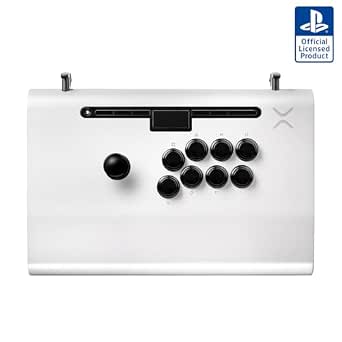
The Victrix Pro FS is a tournament‑ready arcade fight stick built from aircraft‑grade aluminum, featuring genuine Sanwa Denshi buttons and a detachable Link 2 joystick. Its ergonomic wrist slope, foam lap pad, and integrated carrying handles provide comfort and portability for long gaming sessions.
Pros:
- Aircraft‑grade aluminum construction provides exceptional durability.
- Genuine Sanwa Denshi buttons and detachable joystick deliver arcade‑grade responsiveness.
- Ergonomic design with wrist slope, foam pad, and built‑in handles ensures comfort during long sessions.
- Mod-friendly quick‑access back panel allows easy upgrades and cleaning.
Cons:
- Heavy at 7.8 lb, making it bulky to move frequently.
- Large footprint may not fit on smaller desks or gaming setups.
- Limited native compatibility (no Xbox support).
Best for: Players seeking an arcade-style controller for PS5, PS4, or PC.
Not ideal for: Anyone who prefers a standard gamepad or needs unlisted platform support.
Bottom line: Verify game compatibility and the physical layout before choosing this fight stick.
Gaming CRT Television
A CRT television may be part of a retro setup when the systems you plan to use connect to one. Since there is no product pick for this slot, start by identifying the outputs on your console and the inputs available on the television. Check the exact connector types rather than relying on a broad label such as “AV.”
Common buying mistakes include choosing a television before checking its inputs, overlooking physical size, and assuming that any cable with a familiar plug will work. Compare the television’s listed connections with your console and any adapter you intend to use. Check the unit’s dimensions and weight against the space where it will sit, and verify that the display can be safely placed there. If you are buying used, ask the seller to confirm the inputs and that the set powers on; do not infer condition from a listing title alone. Confirm connections and fit first, then decide whether the television suits your room and the systems you want to connect.
What to look for:
- Match television inputs to your console’s video output.
- Confirm the exact connector types before buying cables.
- Measure the available space for the television.
- Check listed dimensions and weight for placement.
- For a used set, confirm its inputs and operating condition.
Console AV Adapter
An AV adapter can bridge a mismatch between a console’s output and a display’s input, so the correct choice depends on both devices. There is no specific product pick for this slot. First write down the exact output and input connections you need to join, using the console and display listings or labels as references.
A frequent mistake is buying an adapter based only on the shape of a plug. Check the signal type and direction the adapter supports, plus any power or setup requirements stated in its listing. An adapter designed to connect one kind of source to a display may not work in reverse. Make sure any separate cables you need are included or accounted for, and confirm that the adapter supports the devices you intend to connect. Avoid adding multiple converters without checking each link in the chain. Trace the full connection path from console to screen before ordering, and choose an adapter whose stated input, output, and direction match that path.
What to look for:
- Identify the console’s exact video and audio output.
- Identify the television or monitor’s matching input.
- Check signal type and adapter direction.
- Confirm power and setup requirements.
- Verify whether required cables are included.
Gaming Memory Card
A memory card may be needed to save progress or data on compatible systems, but the required card depends on the console and game. No product pick is specified here. Start with the exact system model and game you intend to use, then check their documentation or product listings for supported card types and capacity.
Do not assume that cards with similar names or shapes are interchangeable. Check the required format, capacity limits, and whether the console needs a particular card for saving. If purchasing a used card, ask whether it has been tested and whether existing data can be erased; do not count on a used listing to confirm either point unless it says so. Also verify that the card is compatible with the specific console revision you own. Compatibility is system-specific, so confirm the format before buying and avoid choosing by appearance or a generic “gaming” description alone. Buy only the capacity and type that your system supports.
What to look for:
- Confirm the console model and revision.
- Check the supported memory card format.
- Verify capacity limits and game requirements.
- Confirm whether the card is used and tested.
- Check whether existing data can be erased if needed.
Classic Game Controller
The supplied pick is the Classic Ouija Board Game with 1990s Artwork. Its name identifies it as a board game, so check the listing carefully before treating it as a video game controller. The slot calls for a classic game controller, and the product name alone does not establish compatibility with a console or PC.
A common buying mistake is relying on a category label without checking what the item is and what it includes. Read the full description and review the product images to confirm whether the listing is for a board game or an electronic controller. If you need a controller for a particular system, verify the connection type, supported platform, and button layout from the product details. Check whether the item is new or used and what accessories are included. Confirm the item category before purchase; if your goal is console control, select a listing that explicitly identifies itself as a compatible controller for your system.
What to look for:
- Confirm whether the listing is for a board game or electronic controller.
- Check product images and the full description.
- For a controller, verify platform and system compatibility.
- Confirm connection type and control layout.
- Review item condition and included accessories.
Classic Ouija Board Game with 1990s Artwork

This classic Ouija board game features nostalgic 1990s artwork and a wood fiber board with a smooth coating for the plastic planchette. Designed for two or more players ages 8 and up, it is intended for entertainment purposes only.
Pros:
- Nostalgic 1990s artwork
- Sturdy wood fiber construction
- Smooth coating helps the planchette glide
- Suitable for group play and sleepovers
Cons:
- The board is wrapped with a paper label
- Intended for entertainment purposes only
Best for: Shoppers who want to verify this listing before buying.
Not ideal for: Players who need a confirmed console-compatible controller.
Bottom line: The listed product is a board game by name, so verify it meets your controller need.
Use a budget-first buying order: start with the system or games you plan to use, then confirm the display and connection path. Add a memory card or controller only when you know the system requires one and the accessory is compatible. This helps keep the checklist focused on parts your setup can actually use.
Take the setup one connection at a time, checking product details against your own equipment as you go. With a little planning, you can build a comfortable retro gaming setup around the games and hardware that matter to you.


